
When you step into the Spartan Motorsport Performance Lab at Michigan State University, you notice two things immediately: the hum of equipment used to measure human performance and the unmistakable sense that something new is being built here. Not just new research or new data, but a new field. And at the center of it stands second-year medical student in the MSU College of Osteopathic Medicine (MSUCOM) Aidan Davis, partnering with David Ferguson, Ph.D., associate professor of kinesiology at MSU, and Jake Rowan, D.O., associate professor with MSUCOM, to explore something almost nobody has attempted in professional racing: the formal use of osteopathic manipulative medicine (OMM) to assess and improve driver health.
This collaboration is more than a student project. It’s the merging of two niche worlds – motorsport physiology and osteopathic medicine – into a potential new subspecialty.
Where the idea started
Aidan Davis has worked with Dr. Ferguson since 2021, first as an undergraduate student and now as a medical student. During that time, he has helped support research across Formula 1, IndyCar, NASCAR and IMSA. He has traveled to racetracks, helped collect physiological data and learned first-hand how physically punishing race driving can be.
When he began medical school and entered his OMM coursework, something clicked. He remembers sitting in class, learning to evaluate somatic dysfunctions and musculoskeletal imbalances, and suddenly thinking, this would be perfect for motorsports.
Drivers spend hours strapped into narrow cockpits, absorbing G-forces, gripping steering wheels through rapid directional changes and maintaining awkward, fixed postures. “How could there not be dysfunction?” he wondered.
Davis approached Dr. Rowan, one of MSU’s respected OMM physicians, to pitch the idea of a study. Rowan’s first reaction was disbelief – in the best way.
“I assumed someone had already done this,” he said. “But when Aiden explained that it hadn’t, it was obvious we were looking at a real opportunity.”
The unmet need in racing
Unlike stick-and-ball sports, football, basketball, soccer, motorsports rarely offer structured, evidence-based sports medicine support. There are exceptional trackside physicians, but systematic musculoskeletal assessment is limited. Many drivers rely on “performance coaches” with minimal clinical training.
Dr. Ferguson, who directs the Spartan Motorsport Performance Lab and partners with elite racing teams, put it bluntly, “In racing, there is a complete lack of real sports medicine. You might have someone with a big Instagram following calling themselves a therapist, but drivers don’t have the same access to trained professionals that traditional athletes do.”
This is where Davis saw the gap, and where OMM could make a measurable difference.
Building the pilot study
The early phase of the project is simple by design. They are building a screening tool, refining assessment techniques, and testing their flow in a controlled environment before using them at a track.
The protocol is straightforward. First, perform a pre-driving OMM screening and check for asymmetry, evaluate tissue texture, assess range of motion and identify somatic dysfunctions. Next, have the participant drive in MSU’s racing simulator and check steering load, braking pressure, throttle patterns, all with realistic driving scenarios. Then, repeat the OMM assessment afterward and look for new dysfunction while checking for worsening of pre-existing issues, and identify patterns connected to driving mechanics.
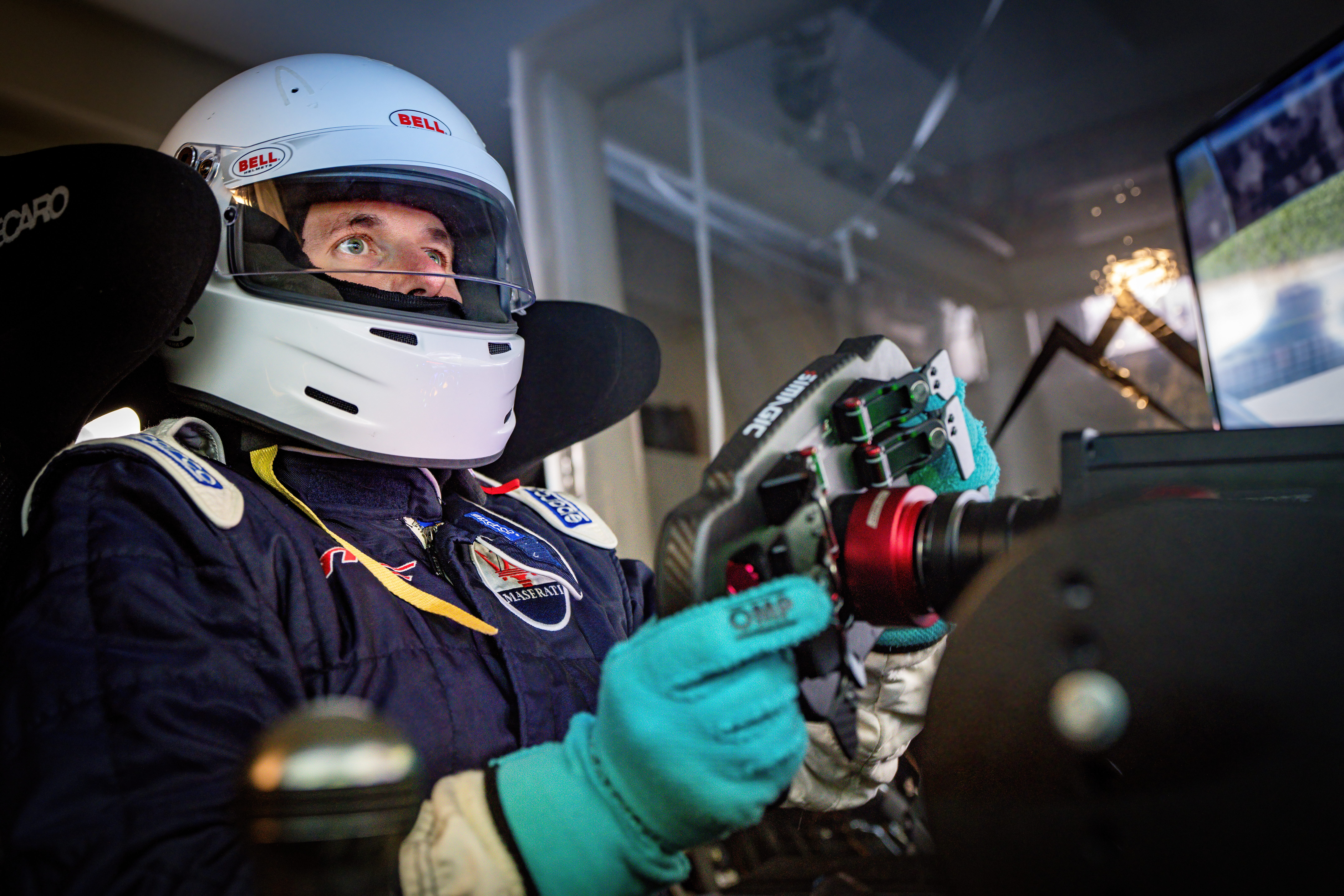
The simulator is essential. Before bringing this to real drivers, the team needs to understand what typical dysfunctions look like, how quickly they appear and whether OMM can meaningfully address them.
For the first test subject, Dr. Ferguson volunteered. The humor wasn’t lost on anyone. “I’ve become the guinea pig,” he laughed. “I used to race 25 years ago, so there are some old bodily injuries that might inform the study process. I’m excited to see how this goes.”
But the purpose was serious – the team needed someone who had real racing experience to generate realistic movement patterns and stress points.
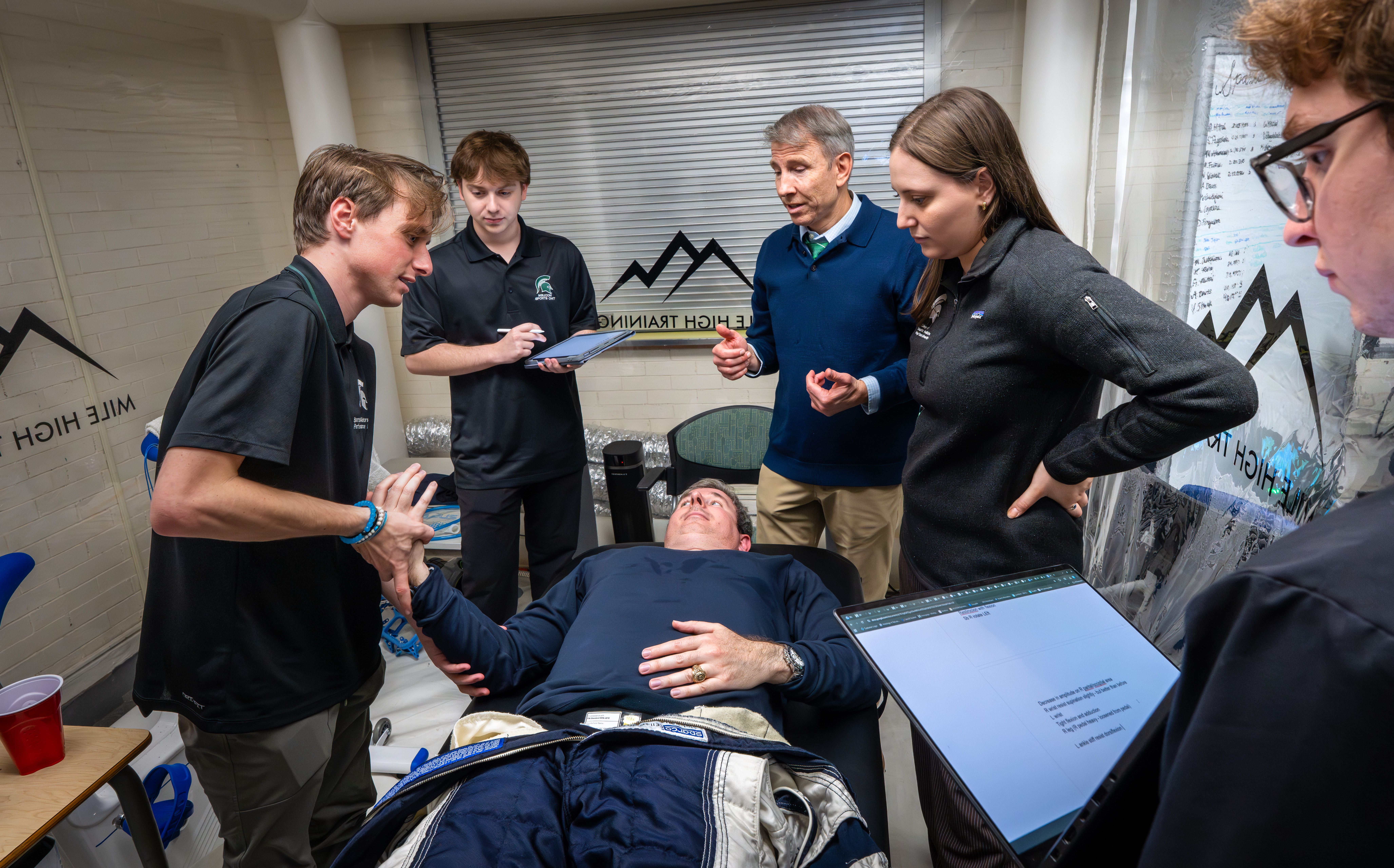
Dr. Rowan has Dr. Ferguson on the exam table, moments after the test run. “I would say that thoracic vertebrae rotated right there at T5. And then here at T8, right at the, the thoracic vertebrae rotated to the left, but the rib is dysfunctional on the right. Got a torsion there.”
Evaluation and review
Dr. Rowan’s approach is rooted in the fundamentals of OMM. He evaluates cervical range of motion sustained force production on the simulator thoracic and rib cage mobility (affected by steering load and bracing), lumbar and pelvic alignment (affected by pedal asymmetry), fascial restrictions (from fixed posture in tight seats) and tissue texture changes indicating strain or compensation.
“We’re evaluating the neuromusculoskeletal system for any asymmetry, range-of-motion restriction, or tissue changes. If we find dysfunction consistently after driving, that suggests OMM, or physical therapy or other modalities, could be used to prevent or treat those issues,” he explained.
The premise sounds obvious: repetitive stress leads to dysfunction. But in racing, almost no one is measuring it, let alone treating it scientifically. This is what makes the study groundbreaking.
A natural fit that somehow never happened
Davis admits he was surprised when he realized OMM had never been applied to motorsports in a formal, research-driven way.
“OMM is niche. Motorsports medicine is niche. So, putting them together means we’re working in a niche of a niche,” he said. “But it also means there’s a huge opportunity to help people who’ve never had this level of care.”
Dr. Rowan agrees. He recalls meeting Davis years earlier on a medical outreach trip in Mérida, Mexico, where Davis first mentioned his motorsport interests.
“When he brought up this idea again, I thought, ‘This is actually perfect.’ It hasn’t been done, and it needs to be.”
From the lab to the track
The long-term plan is ambitious. Bring professional drivers to MSU for full OMM assessments and refine the protocol using multiple drivers across different racing series. Davis and team will then collect pre- and post-race data at live events, identify patterns that correspond to different types of racing, develop motorsports-specific OMM treatment protocols and, eventually, train future physicians to apply OMM trackside.
Top endurance racing teams are already interested. The ultimate goal is to bring the team to major events like the Detroit Grand Prix, running screenings and providing hands-on care.
Why it matters
Motorsport drivers face demanding rigors while behind the wheel. It means prolonged static posture, high G-forces, extreme asymmetry between left and right musculature, vibration exposure, along with the high stress and endurance demands.
Davis says these factors lead to predictable dysfunction. Yet most drivers receive treatment reactively, after pain sets in, rather than proactively through structured assessment. OMM offers a chance to change that by reducing strain and improving mobility while enhancing recovery.
OMM also helps with supporting focus and reaction time, improving performance consistency, all the while preventing injury. All “wins” for these fierce competitors. In a sport where a fraction of a second matters, small improvements can translate into meaningful competitive advantage.
The future of motorsport medicine
There is currently only one motorsport-medicine fellowship in the United States. Only one position opens each year. Davis hopes to pursue it.
With continued growth, the MSU project could become one of the first major research programs blending osteopathic principles and high-performance motorsport physiology. Dr. Ferguson says he sees the big picture, “Once we understand the needs, we can assess and treat them. That’s where these guys come in.”
Dr. Rowan sees a new frontier for his field.
For Aidan Davis, he sees the beginning of the career he has dreamed about. And racing, for the first time, may soon have musculoskeletal care built on real science, not guesswork, thanks to the vision and teamwork of these Spartan doctors.
By Jim Peck
When you step into the Spartan Motorsport Performance Lab at Michigan State University, you notice two things immediately: the hum of equipment used to measure human performance and the unmistakable sense that something new is being built here. Not just new research or new data, but a new field. And at the center of it stands second-year medical student in the MSU College of Osteopathic Medicine (MSUCOM) Aidan Davis, partnering with David Ferguson, Ph.D., associate professor of kinesiology at MSU, and Jake Rowan, D.O., associate professor with MSUCOM, to explore something almost nobody has attempted in professional racing: the formal use of osteopathic manipulative medicine (OMM) to assess and improve driver health.
This collaboration is more than a student project. It’s the merging of two niche worlds – motorsport physiology and osteopathic medicine – into a potential new subspecialty.
Where the idea started
Aidan Davis has worked with Dr. Ferguson since 2021, first as an undergraduate student and now as a medical student. During that time, he has helped support research across Formula 1, IndyCar, NASCAR and IMSA. He has traveled to racetracks, helped collect physiological data and learned first-hand how physically punishing race driving can be.
When he began medical school and entered his OMM coursework, something clicked. He remembers sitting in class, learning to evaluate somatic dysfunctions and musculoskeletal imbalances, and suddenly thinking, this would be perfect for motorsports.
Drivers spend hours strapped into narrow cockpits, absorbing G-forces, gripping steering wheels through rapid directional changes and maintaining awkward, fixed postures. “How could there not be dysfunction?” he wondered.
Davis approached Dr. Rowan, one of MSU’s respected OMM physicians, to pitch the idea of a study. Rowan’s first reaction was disbelief – in the best way.
“I assumed someone had already done this,” he said. “But when Aiden explained that it hadn’t, it was obvious we were looking at a real opportunity.”
The unmet need in racing
Unlike stick-and-ball sports, football, basketball, soccer, motorsports rarely offer structured, evidence-based sports medicine support. There are exceptional trackside physicians, but systematic musculoskeletal assessment is limited. Many drivers rely on “performance coaches” with minimal clinical training.
Dr. Ferguson, who directs the Spartan Motorsport Performance Lab and partners with elite racing teams, put it bluntly, “In racing, there is a complete lack of real sports medicine. You might have someone with a big Instagram following calling themselves a therapist, but drivers don’t have the same access to trained professionals that traditional athletes do.”
This is where Davis saw the gap, and where OMM could make a measurable difference.
Building the pilot study
The early phase of the project is simple by design. They are building a screening tool, refining assessment techniques, and testing their flow in a controlled environment before using them at a track.
The protocol is straightforward. First, perform a pre-driving OMM screening and check for asymmetry, evaluate tissue texture, assess range of motion and identify somatic dysfunctions. Next, have the participant drive in MSU’s racing simulator and check steering load, braking pressure, throttle patterns, all with realistic driving scenarios. Then, repeat the OMM assessment afterward and look for new dysfunction while checking for worsening of pre-existing issues, and identify patterns connected to driving mechanics.
The simulator is essential. Before bringing this to real drivers, the team needs to understand what typical dysfunctions look like, how quickly they appear and whether OMM can meaningfully address them.
For the first test subject, Dr. Ferguson volunteered. The humor wasn’t lost on anyone. “I’ve become the guinea pig,” he laughed. “I used to race 25 years ago, so there are some old bodily injuries that might inform the study process. I’m excited to see how this goes.”
But the purpose was serious – the team needed someone who had real racing experience to generate realistic movement patterns and stress points.
Dr. Rowan has Dr. Ferguson on the exam table, moments after the test run. “I would say that thoracic vertebrae rotated right there at T5. And then here at T8, right at the, the thoracic vertebrae rotated to the left, but the rib is dysfunctional on the right. Got a torsion there.”
Evaluation and review
Dr. Rowan’s approach is rooted in the fundamentals of OMM. He evaluates cervical range of motion sustained force production on the simulator thoracic and rib cage mobility (affected by steering load and bracing), lumbar and pelvic alignment (affected by pedal asymmetry), fascial restrictions (from fixed posture in tight seats) and tissue texture changes indicating strain or compensation.
“We’re evaluating the neuromusculoskeletal system for any asymmetry, range-of-motion restriction, or tissue changes. If we find dysfunction consistently after driving, that suggests OMM, or physical therapy or other modalities, could be used to prevent or treat those issues,” he explained.
The premise sounds obvious: repetitive stress leads to dysfunction. But in racing, almost no one is measuring it, let alone treating it scientifically. This is what makes the study groundbreaking.
A natural fit that somehow never happened
Davis admits he was surprised when he realized OMM had never been applied to motorsports in a formal, research-driven way.
“OMM is niche. Motorsports medicine is niche. So, putting them together means we’re working in a niche of a niche,” he said. “But it also means there’s a huge opportunity to help people who’ve never had this level of care.”
Dr. Rowan agrees. He recalls meeting Davis years earlier on a medical outreach trip in Mérida, Mexico, where Davis first mentioned his motorsport interests.
“When he brought up this idea again, I thought, ‘This is actually perfect.’ It hasn’t been done, and it needs to be.”
From the lab to the track
The long-term plan is ambitious. Bring professional drivers to MSU for full OMM assessments and refine the protocol using multiple drivers across different racing series. Davis and team will then collect pre- and post-race data at live events, identify patterns that correspond to different types of racing, develop motorsports-specific OMM treatment protocols and, eventually, train future physicians to apply OMM trackside.
Top endurance racing teams are already interested. The ultimate goal is to bring the team to major events like the Detroit Grand Prix, running screenings and providing hands-on care.
Why it matters
Motorsport drivers face demanding rigors while behind the wheel. It means prolonged static posture, high G-forces, extreme asymmetry between left and right musculature, vibration exposure, along with the high stress and endurance demands.
Davis says these factors lead to predictable dysfunction. Yet most drivers receive treatment reactively, after pain sets in, rather than proactively through structured assessment. OMM offers a chance to change that by reducing strain and improving mobility while enhancing recovery.
OMM also helps with supporting focus and reaction time, improving performance consistency, all the while preventing injury. All “wins” for these fierce competitors. In a sport where a fraction of a second matters, small improvements can translate into meaningful competitive advantage.
The future of motorsport medicine
There is currently only one motorsport-medicine fellowship in the United States. Only one position opens each year. Davis hopes to pursue it.
With continued growth, the MSU project could become one of the first major research programs blending osteopathic principles and high-performance motorsport physiology. Dr. Ferguson says he sees the big picture, “Once we understand the needs, we can assess and treat them. That’s where these guys come in.”
Dr. Rowan sees a new frontier for his field.
For Aidan Davis, he sees the beginning of the career he has dreamed about. And racing, for the first time, may soon have musculoskeletal care built on real science, not guesswork, thanks to the vision and teamwork of these Spartan doctors.
By Jim Peck