
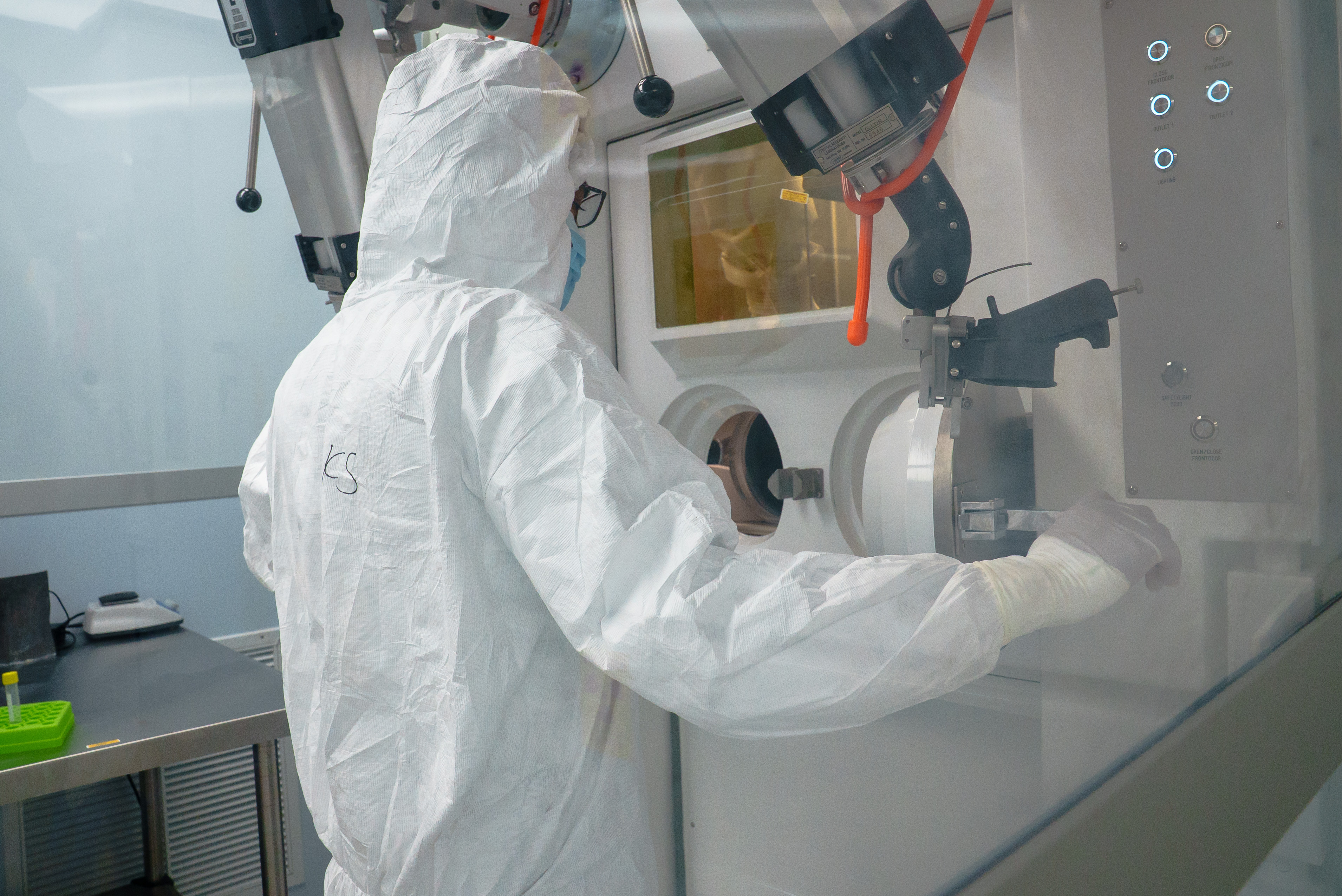
Radiochemistry and Radiopharmacy Solutions, more commonly known as RadCore, has launched an exciting new era of scientific possibility at Michigan State University, with several clinical trials underway fueled by the new central facility – the MSU Radiopharmacy.
RadCore’s mission is to manufacture and transform raw radioisotopes into high-quality imaging and therapeutic agents for research studies in animals and humans. The RadCore space is in the Bioengineering building. The Center for Imaging and Image-Guided Therapies is located directly above the radiopharmacy in Clinical Center D.
“Our facility enables a lot of different kinds of clinical trials to improve human health, both for imaging and therapy, for detection and therapy of cancer, but it also applies to cardiovascular disease and neurosciences, too,” said Kurt Zinn, DVM, MS, Ph.D., a professor in the Departments of Radiology, Biomedical Engineering and Small Animal Clinical Sciences. Dr. Zinn serves as Director of RadCore and is the Hickman Family Endowed Chair in Oncology and Director of Nuclear Medicine at MSU.
“Pretty much every health area is impacted by radiopharmaceuticals now,” he said. “It's a big, growing endeavor.”
A case in point: Pluvicto, a targeted therapy that delivers radiation treatment for prostate cancer, is considered the first blockbuster drug in nuclear medicine – one that is projected to soon grow to a $4 billion industry since it was first approved by the FDA in 2022. Dr. Zinn estimates the market for all radiopharmaceuticals will be about $35 billion in the next five years.
Three major clinical trials currently underway at RadCore focus on type 1 diabetes, bladder cancer and gene therapy imaging, while several other investigations are in early stages of development. RadCore’s facility can make both radioactive and nonradioactive drugs. The diabetes study, supported by the Helmsley Charitable Trust, represents a project where a non-radioactive drug being tested is produced in the radiopharmacy.
The bladder cancer trials include both humans and canines in separate studies and focus on developing radiopharmaceuticals for both diagnostic and therapeutic applications. The gene therapy imaging project is being done in partnership with Henry Ford Health and involves noninvasively monitoring gene therapy effectiveness in real time.
“I'm pleased to say the MSU College of Osteopathic Medicine (MSUCOM) is one of the key investors in RadCore,” Dr. Zinn said. “We can help the investigators, the faculty in Osteopathic Medicine, who are considering doing clinical trials for cancer, or in neuroscience or cardiology. We can play a valuable role in partnering with MSUCOM in all those areas.”
In addition to the MSU College of Osteopathic Medicine, RadCore is also being funded during its first year by the MSU Colleges of Human Medicine and Veterinary Medicine, and the MSU Office of Research and Innovation.
Creating synergies with MSU partners to support One Health
RadCore is working closely with the MSU Drug Discovery Program and two emerging university programs that are advancing clinical trials to improve animal and human health in support of the university’s One Team, One Health initiative -- a transdisciplinary strategy that recognizes the health of people, animals, and the environment are closely connected.
RadCore is creating further synergies by integrating operations with a coalition of MSU colleges and programs called the Clinical Innovations Program (CLIP), which aims to improve the standard of care in human and veterinary medicine through sustainable and innovative clinical research. The MSU College of Osteopathic Medicine is a part of the coalition, which also includes the Colleges of Human Medicine, Veterinary Medicine and Natural Sciences and Agriculture, and the Institute for Quantitative Health Science and Engineering.
RadCore also supplies imaging agents for the new 13,000-square-foot Center for Imaging and Image-Guided Therapies, which is also designed to connect human and animal medical research.
Dr. Zinn spent 22 years at the University of Alabama at Birmingham (UAB), where he led a project to build a $30 million cyclotron and imaging center. Little did he realize that he’d get to lead a similar effort when he came to MSU in 2017. But when MSU Health Care relocated its imaging services on campus to the new Izzo Family Medical Center at McLaren Greater Lansing that sits on MSU’s campus, he seized the opportunity to transform an apparent disadvantage into an amazing opportunity.
“I was part of about 12 clinical trials at UAB when I was there, and I wanted to expand that here at Michigan State,” Dr. Zinn said.” I wanted to do clinical trials with radioactive agents, and there was no way to do that without having a facility on campus to manufacture them. And in the process of converting the existing space here and getting all the necessary approvals over several years, we determined the project should be a core facility to help with clinical trials university-wide, and we got approval for that last year. We decided we wanted to make RadCore a flexible facility to accommodate what we needed to do in research, and that's paid off.”
RadCore is a cGMP (current good manufacturing practice) compliant facility, which means it follows a demanding series of manufacturing and quality assurance procedures, and strict federal regulations to ensure safety and environmental monitoring around the clock. The radiopharmacy has sensors to measure temperature, humidity, air pressure and other factors. Nothing can leak in or out of the clean room. Humans must complete hours of intense training before “suiting up” in full hazmat suits.
“We monitor the facility and try to grow bacteria and fungus on agar plates, but we find no significant growth,” Dr. Zinn said. “I mean, it's a completely sterile environment that must be carefully and continually cleaned to be compliant with a lot of regulations related to the radioactivity and human use. But it's the first and only facility that's existed here on campus that can do these kinds of clinical trials.”
Exciting time for radiopharmaceuticals
Radiopharma is experiencing a surge in investment because of the tremendous potential of new oncology drugs known as “theranostics.”
A combination of the words “therapy” and “diagnostic,” a theranostic is a radiopharmaceutical that simultaneously acts as both a diagnostic tool and as an actual treatment. Theranostics remove the guesswork, giving physicians a high level of certainty in pinpointing the exact location of cancerous cells.
According to a recent GeneOnline article, “The medical community views this shift as moving from a ‘blind treatment’ to a ‘guided-missile’ approach. In traditional chemotherapy, you wait weeks for a scan to see if the drug worked; with [theranostics], the same molecule used for treatment can be swapped with an imaging isotope to confirm the drug has reached the tumor within hours.”
Dr. Zinn agrees that theranostic drugs are increasingly playing a critical role in finding and destroying cancer cells in a much more targeted way. But he said investigators are researching the effectiveness of using a combination of treatments.
“The future will focus on combining targeted radiation therapy to the right patients with immunotherapy,” he explained. “That means killing the cancer with radiation while the immune system is also essentially trained to take care of any cancer that comes back. We call it the abscopal effect.”
For years, both patients and investors have been hesitant to embrace nuclear medicine. In a well-known pop culture reference, even Homer Simpson wields a green, radioactive “glow stick,” symbolizing his careless work with nuclear materials. But that hesitancy seems to be a thing of the past. In fact, Dr. Zinn said most patients likely don’t even realize that a PET (Positron Emission Tomography) scan is a nuclear medicine imaging test that uses a radioactive tracer to help detect diseases like cancer or heart conditions.
“For those of us who have been in the field for 30 or 40 years, it's finally coming to fruition,” Dr. Zinn said. “We're seeing the hard work pay off. People have had a reluctance to be around radioactivity, but over time we’re seeing greater acceptance because the technology has significantly improved and patients recognize that it really does benefit them.”
by Lynn Waldsmith
Radiochemistry and Radiopharmacy Solutions, more commonly known as RadCore, has launched an exciting new era of scientific possibility at Michigan State University, with several clinical trials underway fueled by the new central facility – the MSU Radiopharmacy.
RadCore’s mission is to manufacture and transform raw radioisotopes into high-quality imaging and therapeutic agents for research studies in animals and humans. The RadCore space is in the Bioengineering building. The Center for Imaging and Image-Guided Therapies is located directly above the radiopharmacy in Clinical Center D.
“Our facility enables a lot of different kinds of clinical trials to improve human health, both for imaging and therapy, for detection and therapy of cancer, but it also applies to cardiovascular disease and neurosciences, too,” said Kurt Zinn, DVM, MS, Ph.D., a professor in the Departments of Radiology, Biomedical Engineering and Small Animal Clinical Sciences. Dr. Zinn serves as Director of RadCore and is the Hickman Family Endowed Chair in Oncology and Director of Nuclear Medicine at MSU.
“Pretty much every health area is impacted by radiopharmaceuticals now,” he said. “It's a big, growing endeavor.”
A case in point: Pluvicto, a targeted therapy that delivers radiation treatment for prostate cancer, is considered the first blockbuster drug in nuclear medicine – one that is projected to soon grow to a $4 billion industry since it was first approved by the FDA in 2022. Dr. Zinn estimates the market for all radiopharmaceuticals will be about $35 billion in the next five years.
Three major clinical trials currently underway at RadCore focus on type 1 diabetes, bladder cancer and gene therapy imaging, while several other investigations are in early stages of development. RadCore’s facility can make both radioactive and nonradioactive drugs. The diabetes study, supported by the Helmsley Charitable Trust, represents a project where a non-radioactive drug being tested is produced in the radiopharmacy.
The bladder cancer trials include both humans and canines in separate studies and focus on developing radiopharmaceuticals for both diagnostic and therapeutic applications. The gene therapy imaging project is being done in partnership with Henry Ford Health and involves noninvasively monitoring gene therapy effectiveness in real time.
“I'm pleased to say the MSU College of Osteopathic Medicine (MSUCOM) is one of the key investors in RadCore,” Dr. Zinn said. “We can help the investigators, the faculty in Osteopathic Medicine, who are considering doing clinical trials for cancer, or in neuroscience or cardiology. We can play a valuable role in partnering with MSUCOM in all those areas.”
In addition to the MSU College of Osteopathic Medicine, RadCore is also being funded during its first year by the MSU Colleges of Human Medicine and Veterinary Medicine, and the MSU Office of Research and Innovation.
Creating synergies with MSU partners to support One Health
RadCore is working closely with the MSU Drug Discovery Program and two emerging university programs that are advancing clinical trials to improve animal and human health in support of the university’s One Team, One Health initiative -- a transdisciplinary strategy that recognizes the health of people, animals, and the environment are closely connected.
RadCore is creating further synergies by integrating operations with a coalition of MSU colleges and programs called the Clinical Innovations Program (CLIP), which aims to improve the standard of care in human and veterinary medicine through sustainable and innovative clinical research. The MSU College of Osteopathic Medicine is a part of the coalition, which also includes the Colleges of Human Medicine, Veterinary Medicine and Natural Sciences and Agriculture, and the Institute for Quantitative Health Science and Engineering.
RadCore also supplies imaging agents for the new 13,000-square-foot Center for Imaging and Image-Guided Therapies, which is also designed to connect human and animal medical research.
Dr. Zinn spent 22 years at the University of Alabama at Birmingham (UAB), where he led a project to build a $30 million cyclotron and imaging center. Little did he realize that he’d get to lead a similar effort when he came to MSU in 2017. But when MSU Health Care relocated its imaging services on campus to the new Izzo Family Medical Center at McLaren Greater Lansing that sits on MSU’s campus, he seized the opportunity to transform an apparent disadvantage into an amazing opportunity.
“I was part of about 12 clinical trials at UAB when I was there, and I wanted to expand that here at Michigan State,” Dr. Zinn said.” I wanted to do clinical trials with radioactive agents, and there was no way to do that without having a facility on campus to manufacture them. And in the process of converting the existing space here and getting all the necessary approvals over several years, we determined the project should be a core facility to help with clinical trials university-wide, and we got approval for that last year. We decided we wanted to make RadCore a flexible facility to accommodate what we needed to do in research, and that's paid off.”
RadCore is a cGMP (current good manufacturing practice) compliant facility, which means it follows a demanding series of manufacturing and quality assurance procedures, and strict federal regulations to ensure safety and environmental monitoring around the clock. The radiopharmacy has sensors to measure temperature, humidity, air pressure and other factors. Nothing can leak in or out of the clean room. Humans must complete hours of intense training before “suiting up” in full hazmat suits.
“We monitor the facility and try to grow bacteria and fungus on agar plates, but we find no significant growth,” Dr. Zinn said. “I mean, it's a completely sterile environment that must be carefully and continually cleaned to be compliant with a lot of regulations related to the radioactivity and human use. But it's the first and only facility that's existed here on campus that can do these kinds of clinical trials.”
Exciting time for radiopharmaceuticals
Radiopharma is experiencing a surge in investment because of the tremendous potential of new oncology drugs known as “theranostics.”
A combination of the words “therapy” and “diagnostic,” a theranostic is a radiopharmaceutical that simultaneously acts as both a diagnostic tool and as an actual treatment. Theranostics remove the guesswork, giving physicians a high level of certainty in pinpointing the exact location of cancerous cells.
According to a recent GeneOnline article, “The medical community views this shift as moving from a ‘blind treatment’ to a ‘guided-missile’ approach. In traditional chemotherapy, you wait weeks for a scan to see if the drug worked; with [theranostics], the same molecule used for treatment can be swapped with an imaging isotope to confirm the drug has reached the tumor within hours.”
Dr. Zinn agrees that theranostic drugs are increasingly playing a critical role in finding and destroying cancer cells in a much more targeted way. But he said investigators are researching the effectiveness of using a combination of treatments.
“The future will focus on combining targeted radiation therapy to the right patients with immunotherapy,” he explained. “That means killing the cancer with radiation while the immune system is also essentially trained to take care of any cancer that comes back. We call it the abscopal effect.”
For years, both patients and investors have been hesitant to embrace nuclear medicine. In a well-known pop culture reference, even Homer Simpson wields a green, radioactive “glow stick,” symbolizing his careless work with nuclear materials. But that hesitancy seems to be a thing of the past. In fact, Dr. Zinn said most patients likely don’t even realize that a PET (Positron Emission Tomography) scan is a nuclear medicine imaging test that uses a radioactive tracer to help detect diseases like cancer or heart conditions.
“For those of us who have been in the field for 30 or 40 years, it's finally coming to fruition,” Dr. Zinn said. “We're seeing the hard work pay off. People have had a reluctance to be around radioactivity, but over time we’re seeing greater acceptance because the technology has significantly improved and patients recognize that it really does benefit them.”
by Lynn Waldsmith