
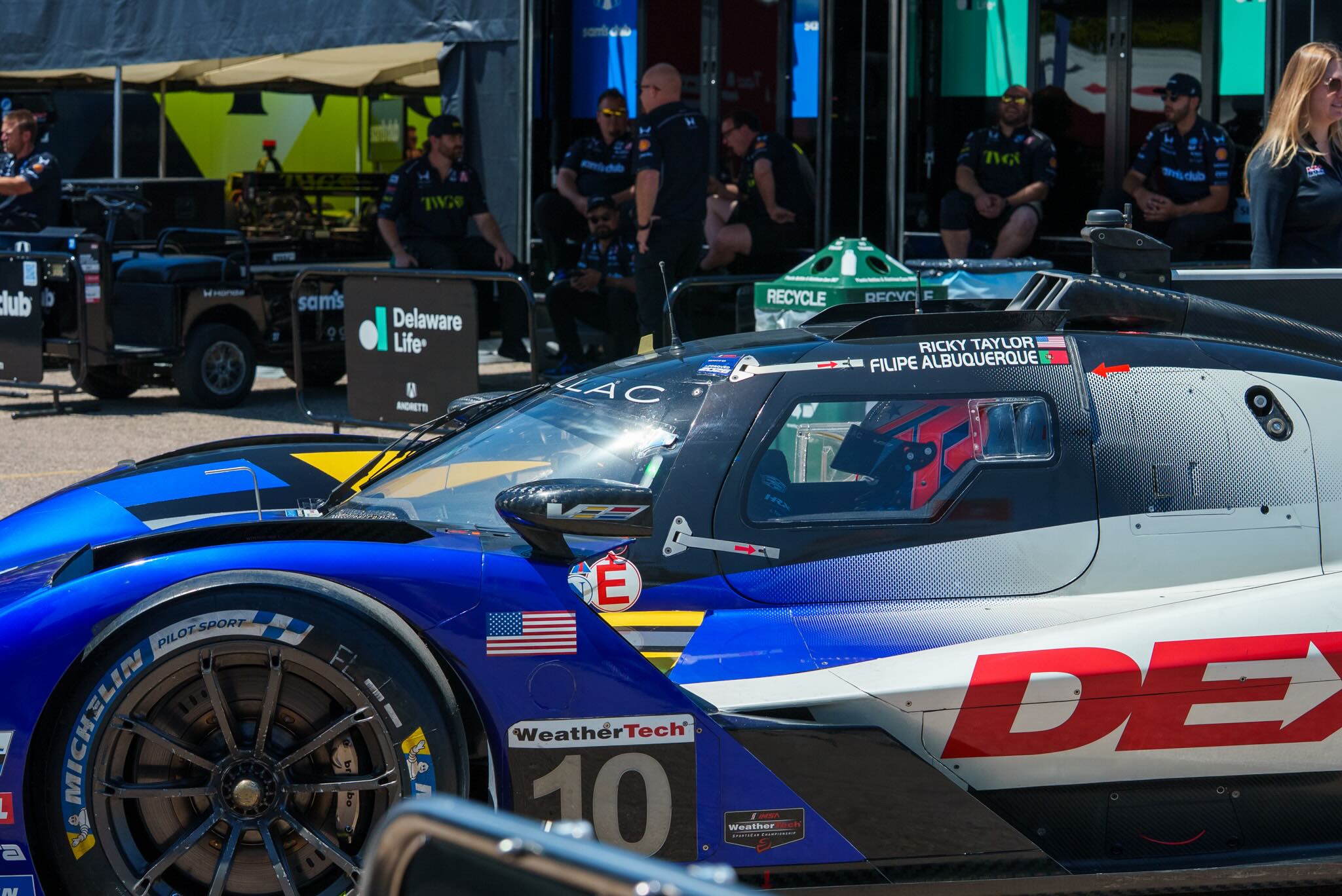
Two osteopathic medical students – one at the Michigan State University College of Osteopathic Medicine (MSUCOM) and the other at Lake Erie College of Osteopathic Medicine (LECOM) – received a grant from the American Osteopathic Association (AOA) to explore how osteopathic medicine can support the health and performance of professional race car drivers. The AOA Osteopathic Medical Student Research Grant will help investigate how osteopathic manipulative medicine (OMM) can be integrated into motorsports.
Aidan Davis, a third-year osteopathic medical student at MSUCOM, and Alyssa Paquette, a third-year student at LECOM’s Bradenton, Fla. campus, are collaborating on the research, which is being conducted through the Spartan Motorsport Performance Lab at MSU under the mentorship of David Ferguson, Ph.D., associate professor in the Department of Kinesiology. The project also brings together expertise from the MSUCOM through collaborations with Jake Rowan, D.O., associate professor, and John Popovich, Ph.D., ATC, D.P.T., associate director of MSUCOM's Center for Neuromusculoskeletal Clinical Research.
The students explain that for decades the pursuit of speed in professional motorsports has focused almost entirely on the race car – centered on refining aerodynamics, developing more powerful engines and teams investing hundreds of thousands of dollars to gain mere fractions of a second on the track. But their research collaboration instead is focused on the next competitive advantage, which may not come from the car, but rather from the driver.
On July 1, Davis and Paquette were awarded a $5,000 one-year grant – the maximum for an Osteopathic Medical Student Research Grant. Over the next year, they plan to use the funding to attend races like the 24 Hours of Daytona, the 12 Hours of Sebring, and the Detroit Grand Prix. At the conclusion of their data collection, they will submit a manuscript to the Journal of Osteopathic Medicine about their research findings.
While previous research at the Spartan Motorsport Performance Lab has focused on driver physiology, heat stress, injury prevention, nutrition and athletic performance, this project marks the laboratory's first investigation centered on OMM.
“The research question is similar to our investigations we’ve done, and that is, what does the race car do to the body, and how can OMM help that,” Davis said. “We want to explore the use of osteopathic manipulative medicine to assess and improve driver health, which is something that is used in nearly every other sport, especially in Michigan State Athletics, but it has largely been absent in professional racing.”
OMM includes hands-on therapy used by osteopathic physicians to diagnose and treat musculoskeletal conditions in the muscles, bones and joints. Ideally, the treatment is designed to promote the body’s natural healing abilities and improve overall mobility.
Dr. Ferguson, Davis, Paquette and the team from MSU’s Spartan Motorsport Performance Lab, emphasize that the future doesn’t belong so much to the vehicle but to the human body. “As Dr. Ferguson has pointed out many times, the cheapest way to go faster is to engineer the driver rather than the car,” Davis said.
Motorsport drivers face demanding rigors while behind the wheel. It means prolonged static posture, high G-forces, extreme asymmetry between left and right musculature, vibration exposure, along with the high stress and endurance demands.
Davis says these factors can lead to predictable dysfunction. Yet most drivers receive treatment reactively, after pain sets in, rather than proactively through structured assessment. OMM offers a chance to change that by reducing strain and improving mobility while enhancing recovery.
OMM can possibly help with supporting focus and reaction time, improving performance consistency, all the while preventing injury. All “wins” for these fierce competitors. In a sport where a fraction of a second matters, small improvements can translate into meaningful competitive advantage.
Besides determining how to best integrate osteopathic manipulative medicine into motorsports, educating drivers can also pose a challenge. Many people may not fully understand OMM, or they equate it with chiropractic care. “But OMM looks at the body holistically,” Davis noted.
“With OMM, we can see how your visceral organs and autonomic nervous system affect your muscles and vice versa. We use a lot of gentle pressure, stretching, and resistance,” Paquette said. “There are just tons of interconnections within the body so it’s a multi-faceted, holistic approach.”
Both Davis and Paquette share a passion for auto racing and helping improve driver outcomes through OMM. Paquette has always been interested in sports medicine and reached out to Davis about a year ago to suggest the possibility of pursuing an osteopathic project after hearing about his work with the Spartan Motorsport Performance Lab.
“I first was interested in Formula 1, then it progressed to IndyCar, and now I'm trying to expand a bit more to other series,” Paquette said. “I was really drawn to the fact that in motorsports, you're trying to enhance and maximize performance, give it every effort you can. And that, I felt, aligned with medicine, in a way. You're trying to find the most effective and comprehensive treatment process for the individual patient or athlete themselves.”
While Davis was growing up, his dad took him to the Detroit Grand Prix every year and sparked his passion of motorsports from a young age. Since 2021, throughout his undergraduate education, Davis worked under Dr. Ferguson on various racing projects, supporting research across Formula 1, IndyCar, NASCAR and IMSA by traveling to racetracks and helping collect physiological data.
While Paquette and Davis thoroughly enjoy their motorsports research, when it comes to their future careers, both are open to all the possibilities that osteopathic medicine might offer.
“I'm interested in physical medicine and rehabilitation, and sports medicine has always been a passion of mine," Paquette said. "If that path eventually includes motorsports, that would be incredible. But I'm more so focused on being a good doctor and providing care to whoever needs it.”
For Davis, the project represents another step toward combining two lifelong passions. "I've loved motorsports for as long as I can remember," he said. "Medicine has given me the opportunity to contribute to the sport in a completely different way. We're hopeful this research will help grow the role of osteopathic medicine in motorsports and ultimately improve the health and care of the athletes behind the wheel."
The research grant runs from July 2026 through June 2027.
by Lynn Waldsmith
Two osteopathic medical students – one at the Michigan State University College of Osteopathic Medicine (MSUCOM) and the other at Lake Erie College of Osteopathic Medicine (LECOM) – received a grant from the American Osteopathic Association (AOA) to explore how osteopathic medicine can support the health and performance of professional race car drivers. The AOA Osteopathic Medical Student Research Grant will help investigate how osteopathic manipulative medicine (OMM) can be integrated into motorsports.
Aidan Davis, a third-year osteopathic medical student at MSUCOM, and Alyssa Paquette, a third-year student at LECOM’s Bradenton, Fla. campus, are collaborating on the research, which is being conducted through the Spartan Motorsport Performance Lab at MSU under the mentorship of David Ferguson, Ph.D., associate professor in the Department of Kinesiology. The project also brings together expertise from the MSUCOM through collaborations with Jake Rowan, D.O., associate professor, and John Popovich, Ph.D., ATC, D.P.T., associate director of MSUCOM's Center for Neuromusculoskeletal Clinical Research.
The students explain that for decades the pursuit of speed in professional motorsports has focused almost entirely on the race car – centered on refining aerodynamics, developing more powerful engines and teams investing hundreds of thousands of dollars to gain mere fractions of a second on the track. But their research collaboration instead is focused on the next competitive advantage, which may not come from the car, but rather from the driver.
On July 1, Davis and Paquette were awarded a $5,000 one-year grant – the maximum for an Osteopathic Medical Student Research Grant. Over the next year, they plan to use the funding to attend races like the 24 Hours of Daytona, the 12 Hours of Sebring, and the Detroit Grand Prix. At the conclusion of their data collection, they will submit a manuscript to the Journal of Osteopathic Medicine about their research findings.
While previous research at the Spartan Motorsport Performance Lab has focused on driver physiology, heat stress, injury prevention, nutrition and athletic performance, this project marks the laboratory's first investigation centered on OMM.
“The research question is similar to our investigations we’ve done, and that is, what does the race car do to the body, and how can OMM help that,” Davis said. “We want to explore the use of osteopathic manipulative medicine to assess and improve driver health, which is something that is used in nearly every other sport, especially in Michigan State Athletics, but it has largely been absent in professional racing.”
OMM includes hands-on therapy used by osteopathic physicians to diagnose and treat musculoskeletal conditions in the muscles, bones and joints. Ideally, the treatment is designed to promote the body’s natural healing abilities and improve overall mobility.
Dr. Ferguson, Davis, Paquette and the team from MSU’s Spartan Motorsport Performance Lab, emphasize that the future doesn’t belong so much to the vehicle but to the human body. “As Dr. Ferguson has pointed out many times, the cheapest way to go faster is to engineer the driver rather than the car,” Davis said.
Motorsport drivers face demanding rigors while behind the wheel. It means prolonged static posture, high G-forces, extreme asymmetry between left and right musculature, vibration exposure, along with the high stress and endurance demands.
Davis says these factors can lead to predictable dysfunction. Yet most drivers receive treatment reactively, after pain sets in, rather than proactively through structured assessment. OMM offers a chance to change that by reducing strain and improving mobility while enhancing recovery.
OMM can possibly help with supporting focus and reaction time, improving performance consistency, all the while preventing injury. All “wins” for these fierce competitors. In a sport where a fraction of a second matters, small improvements can translate into meaningful competitive advantage.
Besides determining how to best integrate osteopathic manipulative medicine into motorsports, educating drivers can also pose a challenge. Many people may not fully understand OMM, or they equate it with chiropractic care. “But OMM looks at the body holistically,” Davis noted.
“With OMM, we can see how your visceral organs and autonomic nervous system affect your muscles and vice versa. We use a lot of gentle pressure, stretching, and resistance,” Paquette said. “There are just tons of interconnections within the body so it’s a multi-faceted, holistic approach.”
Both Davis and Paquette share a passion for auto racing and helping improve driver outcomes through OMM. Paquette has always been interested in sports medicine and reached out to Davis about a year ago to suggest the possibility of pursuing an osteopathic project after hearing about his work with the Spartan Motorsport Performance Lab.
“I first was interested in Formula 1, then it progressed to IndyCar, and now I'm trying to expand a bit more to other series,” Paquette said. “I was really drawn to the fact that in motorsports, you're trying to enhance and maximize performance, give it every effort you can. And that, I felt, aligned with medicine, in a way. You're trying to find the most effective and comprehensive treatment process for the individual patient or athlete themselves.”
While Davis was growing up, his dad took him to the Detroit Grand Prix every year and sparked his passion of motorsports from a young age. Since 2021, throughout his undergraduate education, Davis worked under Dr. Ferguson on various racing projects, supporting research across Formula 1, IndyCar, NASCAR and IMSA by traveling to racetracks and helping collect physiological data.
While Paquette and Davis thoroughly enjoy their motorsports research, when it comes to their future careers, both are open to all the possibilities that osteopathic medicine might offer.
“I'm interested in physical medicine and rehabilitation, and sports medicine has always been a passion of mine," Paquette said. "If that path eventually includes motorsports, that would be incredible. But I'm more so focused on being a good doctor and providing care to whoever needs it.”
For Davis, the project represents another step toward combining two lifelong passions. "I've loved motorsports for as long as I can remember," he said. "Medicine has given me the opportunity to contribute to the sport in a completely different way. We're hopeful this research will help grow the role of osteopathic medicine in motorsports and ultimately improve the health and care of the athletes behind the wheel."
The research grant runs from July 2026 through June 2027.
by Lynn Waldsmith