
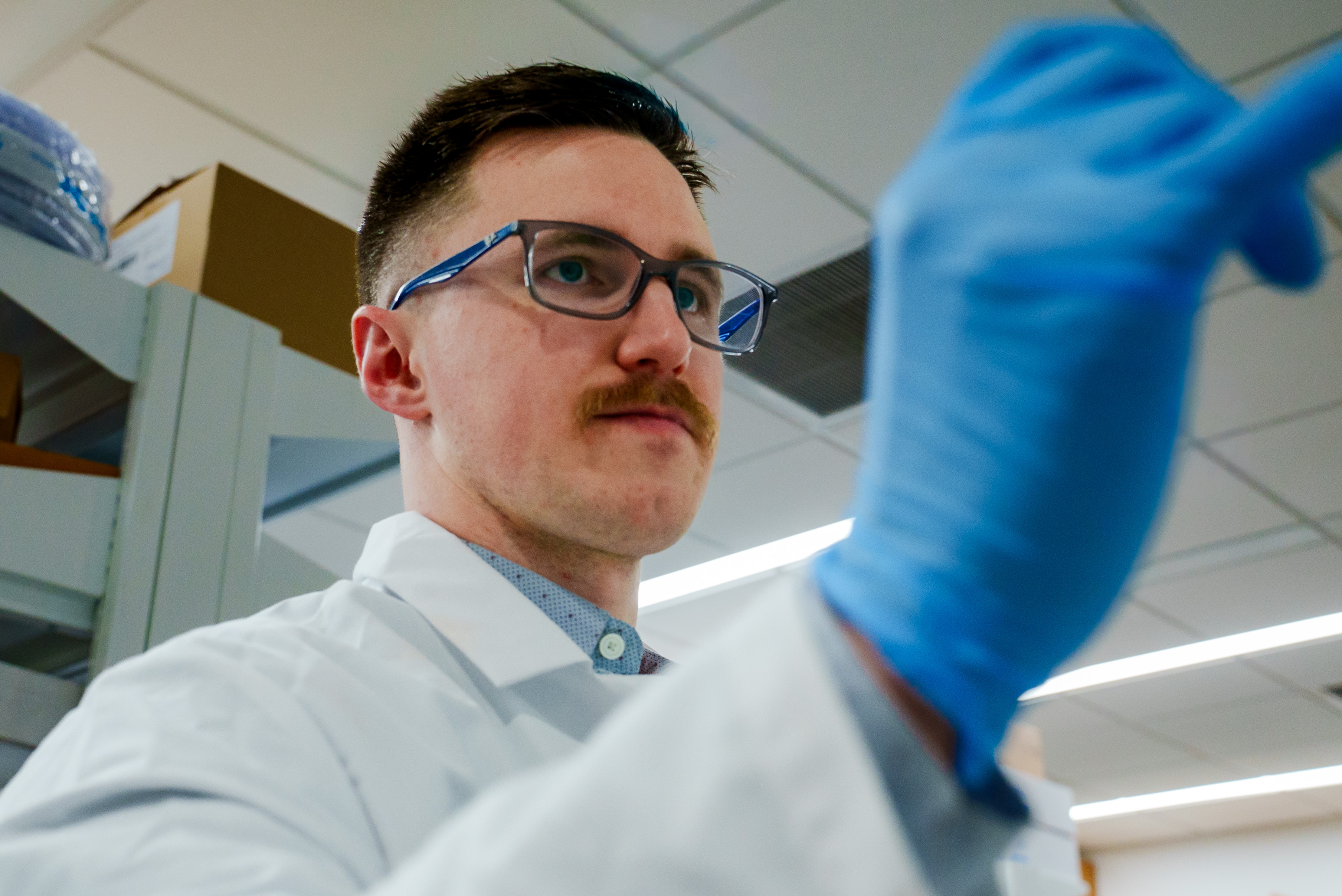
Colin O’Hern loves to talk about Maryland crab feasts like they are a food group, and he is completely captivated by the human heart – not the symbolic one, the literal one. The one that beats, conducts electricity, scars, heals and sometimes, without warning, falls out of rhythm.
O’Hern is pursuing a dual degree – both the Doctor of Osteopathic Medicine (D.O.) degree and a Ph.D. as part of the Michigan State University College of Osteopathic Medicine’s Medical Scientist Training Program. He is one of the first students in the college’s program to receive the T32 grant since it was recognized as a National Institutes of Health (NIH) Medical Scientist Training Program (MSTP). The college received the NIH MSTP designation in 2025 – the first osteopathic medical school to be recognized in the 61-year history of the MSTP T32 at NIH.
O’Hern’s research has been focused on growing miniature human hearts in a laboratory. To understand why he is working in this area, you have to start in his home state of Maryland and follow the road that brought him to East Lansing, where he learned what it means to be a Spartan Doctor.
Where service met science
Growing up outside of Baltimore, O’Hern was drawn to two things that did not seem obviously connected – he loved science classes and volunteering in his community. Helping people felt meaningful. So did understanding how the world worked at a molecular level.
Medicine, he realized, could be where his interests intersected.
At the University of Maryland, Baltimore County, he joined a research lab early and discovered he did not just like science, he loved discovery, he loved asking questions no one had answered and working patiently, determinedly toward those answers.
By the time he applied to medical school, he knew he did not want to choose between caring for patients and doing research that could impact millions. MSU is home to the largest and longest running D.O.-Ph.D. Physician Scientist Training program in the country and where O’Hern’s passions could intersect. Colin talks about the osteopathic philosophy – that structure and function interrelated, the body is capable of self-regulation and that mind, body and spirit are inseparable – matching how he already viewed biology.
The lab that grows hearts
When O’Hern joined the lab of Aitor Aguirre, assistant professor in the Department of Biomedical Engineering at MSU, the team was pioneering the first human heart organoids. Nearly 90% of drugs that work in animals fail in humans. If researchers want to understand human heart disease and develop treatments that work, they need human models.
These are tiny, beating models of human heart tissue grown from stem cells. O’Hern’s contribution began with a simple question: What is missing? His answer was immune cells called macrophages.
When he integrated macrophages into the mini hearts, the organoids became more advanced and more realistic. The macrophages helped conduct electrical signals, altered tissue structure and communicated constantly with surrounding cells. In osteopathic terms, structure changed function.
COVID, soccer and a new question
During the COVID-19 pandemic, several high-profile athletes collapsed from sudden arrhythmias. COVID-19 is inflammatory. Arrhythmias are electrical.
O’Hern began asking what the connection was between inflammation and heart rhythm. Using the macrophage-integrated organoids, he exposed the mini hearts to pro-inflammatory factors similar to those seen during illness. After weeks, the tiny hearts began beating irregularly in patterns similar to atrial fibrillation.
For the first time, this inflammatory mechanism was demonstrated definitively in human heart tissue.
The finding matters for an estimated 60 million people worldwide living with arrhythmias. Few new antiarrhythmic drugs for rhythm control have reached clinical practice in recent decades. This model offers a new way to test therapies in tissue that closely resembles a real human heart.
Osteopathic thinking in the research lab and as a physician
O’Hern said in the lab they constantly think about how structure affects function – an osteopathic principle.
Macrophages changing collagen. Tissue structure altering electrical rhythm. Inflammation disrupting cellular behavior. The philosophy he learns in lecture shows up under the microscope.
He does not see the D.O. and Ph.D. degrees as separate tracks; he sees them as the same way of thinking applied in different settings.
For O’Hern, being a Spartan Doctor is more than wearing green and white. It is a mindset. It is the belief that opportunity exists across a large research university for those willing to seek it out. It is collaboration across disciplines. It is curiosity paired with grit. It is also the belief that osteopathic physicians belong at the forefront of scientific discovery, as well as patient care.
Looking ahead to cardiology and legacy
As he prepares to return to clinical training and eventually residency in his D.O.-Ph.D. tract, O’Hern is thinking about cardiology. Cardiovascular disease remains the leading cause of death worldwide, which ties into his goals. He wants to work on problems that affect as many people as possible.
As a physician, he will serve his community. As a scientist, he hopes to serve millions. He speaks about legacy not in terms of recognition, but responsibility. If he has the skills to ask important questions about the heart, he believes he should use them.
His story is about more than growing hearts in a dish. It is about understanding the heart as both a biological organ and a symbol of service. It’s about a student from Maryland who found a place where he did not have to choose between science and service. And it is about what happens when a Spartan Doctor decides to understand the heart well enough to help it beat longer, steadier and healthier for people around the world.
by Jim Peck
Colin O’Hern loves to talk about Maryland crab feasts like they are a food group, and he is completely captivated by the human heart – not the symbolic one, the literal one. The one that beats, conducts electricity, scars, heals and sometimes, without warning, falls out of rhythm.
O’Hern is pursuing a dual degree – both the Doctor of Osteopathic Medicine (D.O.) degree and a Ph.D. as part of the Michigan State University College of Osteopathic Medicine’s Medical Scientist Training Program. He is one of the first students in the college’s program to receive the T32 grant since it was recognized as a National Institutes of Health (NIH) Medical Scientist Training Program (MSTP). The college received the NIH MSTP designation in 2025 – the first osteopathic medical school to be recognized in the 61-year history of the MSTP T32 at NIH.
O’Hern’s research has been focused on growing miniature human hearts in a laboratory. To understand why he is working in this area, you have to start in his home state of Maryland and follow the road that brought him to East Lansing, where he learned what it means to be a Spartan Doctor.
Where service met science
Growing up outside of Baltimore, O’Hern was drawn to two things that did not seem obviously connected – he loved science classes and volunteering in his community. Helping people felt meaningful. So did understanding how the world worked at a molecular level.
Medicine, he realized, could be where his interests intersected.
At the University of Maryland, Baltimore County, he joined a research lab early and discovered he did not just like science, he loved discovery, he loved asking questions no one had answered and working patiently, determinedly toward those answers.
By the time he applied to medical school, he knew he did not want to choose between caring for patients and doing research that could impact millions. MSU is home to the largest and longest running D.O.-Ph.D. Physician Scientist Training program in the country and where O’Hern’s passions could intersect. Colin talks about the osteopathic philosophy – that structure and function interrelated, the body is capable of self-regulation and that mind, body and spirit are inseparable – matching how he already viewed biology.
The lab that grows hearts
When O’Hern joined the lab of Aitor Aguirre, assistant professor in the Department of Biomedical Engineering at MSU, the team was pioneering the first human heart organoids. Nearly 90% of drugs that work in animals fail in humans. If researchers want to understand human heart disease and develop treatments that work, they need human models.
These are tiny, beating models of human heart tissue grown from stem cells. O’Hern’s contribution began with a simple question: What is missing? His answer was immune cells called macrophages.
When he integrated macrophages into the mini hearts, the organoids became more advanced and more realistic. The macrophages helped conduct electrical signals, altered tissue structure and communicated constantly with surrounding cells. In osteopathic terms, structure changed function.
COVID, soccer and a new question
During the COVID-19 pandemic, several high-profile athletes collapsed from sudden arrhythmias. COVID-19 is inflammatory. Arrhythmias are electrical.
O’Hern began asking what the connection was between inflammation and heart rhythm. Using the macrophage-integrated organoids, he exposed the mini hearts to pro-inflammatory factors similar to those seen during illness. After weeks, the tiny hearts began beating irregularly in patterns similar to atrial fibrillation.
For the first time, this inflammatory mechanism was demonstrated definitively in human heart tissue.
The finding matters for an estimated 60 million people worldwide living with arrhythmias. Few new antiarrhythmic drugs for rhythm control have reached clinical practice in recent decades. This model offers a new way to test therapies in tissue that closely resembles a real human heart.
Osteopathic thinking in the research lab and as a physician
O’Hern said in the lab they constantly think about how structure affects function – an osteopathic principle.
Macrophages changing collagen. Tissue structure altering electrical rhythm. Inflammation disrupting cellular behavior. The philosophy he learns in lecture shows up under the microscope.
He does not see the D.O. and Ph.D. degrees as separate tracks; he sees them as the same way of thinking applied in different settings.
For O’Hern, being a Spartan Doctor is more than wearing green and white. It is a mindset. It is the belief that opportunity exists across a large research university for those willing to seek it out. It is collaboration across disciplines. It is curiosity paired with grit. It is also the belief that osteopathic physicians belong at the forefront of scientific discovery, as well as patient care.
Looking ahead to cardiology and legacy
As he prepares to return to clinical training and eventually residency in his D.O.-Ph.D. tract, O’Hern is thinking about cardiology. Cardiovascular disease remains the leading cause of death worldwide, which ties into his goals. He wants to work on problems that affect as many people as possible.
As a physician, he will serve his community. As a scientist, he hopes to serve millions. He speaks about legacy not in terms of recognition, but responsibility. If he has the skills to ask important questions about the heart, he believes he should use them.
His story is about more than growing hearts in a dish. It is about understanding the heart as both a biological organ and a symbol of service. It’s about a student from Maryland who found a place where he did not have to choose between science and service. And it is about what happens when a Spartan Doctor decides to understand the heart well enough to help it beat longer, steadier and healthier for people around the world.
by Jim Peck