
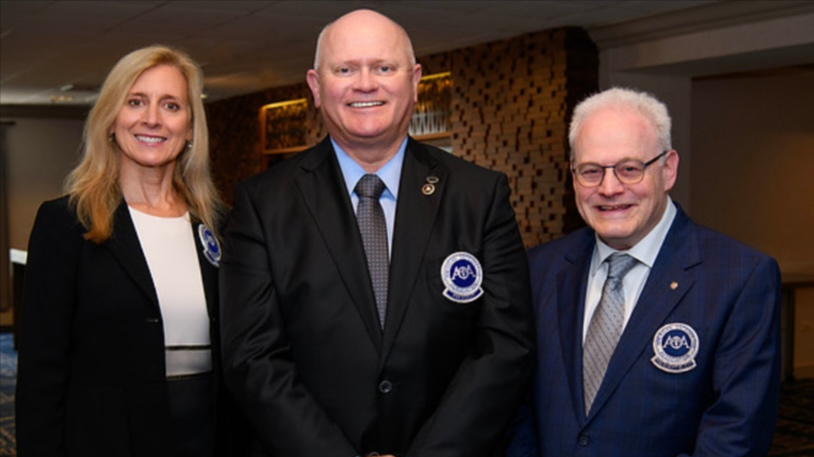
Bruce A. Wolf, D.O., FAOCR, Patenge Award recipient, associate dean at the Macomb site and associate professor at the Michigan State University College of Osteopathic Medicine, was elected to serve as the 2026-2027 president-elect of the American Osteopathic Association (AOA).
Dr. Wolf earned his undergraduate degree from Eastern Michigan University and his Doctor of Osteopathic Medicine (D.O.) from the Chicago College of Osteopathic Medicine of Midwestern University. He did an internship and residency with the Pontiac Osteopathic Hospital, Pontiac, Mich. Dr. Wolf also completed a fellowship in Vascular and Interventional Radiology at Lehigh Valley Hospital, affiliated with Penn State University, Allentown, PA. He joined MSUCOM faculty in 2016 and began serving as dean for the MSUCOM Macomb site in January 2021.
As president-elect, Dr. Wolf will support AOA President Richard Thacker, D.O. and work to advance his initiatives and represent the profession on behalf of the AOA. Dr. Wolf will develop his initiatives for his presidency that will begin in July 2027.
Dr. Wolf joins a small group of MSUCOM alumni and faculty who have served in this role, which will lead to serving as AOA president for the 2027-2028 year. The MSU College of Osteopathic Medicine’s history with AOA is recognition of the quality of people at MSUCOM and who graduate from MSUCOM.
“Dr. Bruce Wolf is an outstanding academic and clinical leader who has made extraordinary contributions to our college and to osteopathic medicine more broadly,” said MSUCOM Dean Joyce deJong, D.O. “As dean of our Macomb campus, he has built strong educational and clinical partnerships while continuing to serve patients as a practicing radiologist. His commitment to education, patient care and service reflects the very best of our profession and makes him exceptionally well suited to serve as AOA President-Elect.”
Learn more from Dr. Wolf in this Q&A.
Why did you want to serve as president-elect and president of AOA?
Early in my career, two mentors encouraged me to become involved with organized medicine at the county and state level. My interest blossomed from there. It is an amazing feeling to be able to work with colleagues from around the country to be able to influence and shape medical policy. As they say, it is better to be at the table instead of on the menu! I am also giving back to the profession for affording me the opportunities that I have had. Few radiologists have taken this path, and I am honored to lead the way for the next generation.
What is the biggest thing you believe faces osteopathic medicine today?
The lack of affinity and distinctiveness of osteopathic medicine. We need to continue to cultivate the background and tenets of osteopathic medicine with our students. Students should embrace the uniqueness of the profession and not just settle for getting into a medical school.
How has your time with MSU uniquely prepared you for this role as AOA president?
I think that my background provides a unique perspective. The first part of my career I was clinical working in a hospital. Coming to MSU, my career has evolved to academics. In addition, I have honed my leadership and administrative skills with my dean’s role. I spent a number of years serving my patients practicing interventional radiology. Now, I teach osteopathic medical students who will become the next generation of osteopathic physicians. This combination puts me in the position to serve all of the profession.
Why is this position important to osteopathic medicine and to patients across the nation?
The osteopathic profession is experiencing tremendous growth with osteopathic medical students representing ~25% of all medical students. There are over 207,000 osteopathic physicians and medical students. These physicians not only look for the disease or problem a patient is experiencing, but also hands-on care to help find the cause and how the body can participate in its own healing.
Bruce A. Wolf, D.O., FAOCR, Patenge Award recipient, associate dean at the Macomb site and associate professor at the Michigan State University College of Osteopathic Medicine, was elected to serve as the 2026-2027 president-elect of the American Osteopathic Association (AOA).
Dr. Wolf earned his undergraduate degree from Eastern Michigan University and his Doctor of Osteopathic Medicine (D.O.) from the Chicago College of Osteopathic Medicine of Midwestern University. He did an internship and residency with the Pontiac Osteopathic Hospital, Pontiac, Mich. Dr. Wolf also completed a fellowship in Vascular and Interventional Radiology at Lehigh Valley Hospital, affiliated with Penn State University, Allentown, PA. He joined MSUCOM faculty in 2016 and began serving as dean for the MSUCOM Macomb site in January 2021.
As president-elect, Dr. Wolf will support AOA President Richard Thacker, D.O. and work to advance his initiatives and represent the profession on behalf of the AOA. Dr. Wolf will develop his initiatives for his presidency that will begin in July 2027.
Dr. Wolf joins a small group of MSUCOM alumni and faculty who have served in this role, which will lead to serving as AOA president for the 2027-2028 year. The MSU College of Osteopathic Medicine’s history with AOA is recognition of the quality of people at MSUCOM and who graduate from MSUCOM.
“Dr. Bruce Wolf is an outstanding academic and clinical leader who has made extraordinary contributions to our college and to osteopathic medicine more broadly,” said MSUCOM Dean Joyce deJong, D.O. “As dean of our Macomb campus, he has built strong educational and clinical partnerships while continuing to serve patients as a practicing radiologist. His commitment to education, patient care and service reflects the very best of our profession and makes him exceptionally well suited to serve as AOA President-Elect.”
Learn more from Dr. Wolf in this Q&A.
Why did you want to serve as president-elect and president of AOA?
Early in my career, two mentors encouraged me to become involved with organized medicine at the county and state level. My interest blossomed from there. It is an amazing feeling to be able to work with colleagues from around the country to be able to influence and shape medical policy. As they say, it is better to be at the table instead of on the menu! I am also giving back to the profession for affording me the opportunities that I have had. Few radiologists have taken this path, and I am honored to lead the way for the next generation.
What is the biggest thing you believe faces osteopathic medicine today?
The lack of affinity and distinctiveness of osteopathic medicine. We need to continue to cultivate the background and tenets of osteopathic medicine with our students. Students should embrace the uniqueness of the profession and not just settle for getting into a medical school.
How has your time with MSU uniquely prepared you for this role as AOA president?
I think that my background provides a unique perspective. The first part of my career I was clinical working in a hospital. Coming to MSU, my career has evolved to academics. In addition, I have honed my leadership and administrative skills with my dean’s role. I spent a number of years serving my patients practicing interventional radiology. Now, I teach osteopathic medical students who will become the next generation of osteopathic physicians. This combination puts me in the position to serve all of the profession.
Why is this position important to osteopathic medicine and to patients across the nation?
The osteopathic profession is experiencing tremendous growth with osteopathic medical students representing ~25% of all medical students. There are over 207,000 osteopathic physicians and medical students. These physicians not only look for the disease or problem a patient is experiencing, but also hands-on care to help find the cause and how the body can participate in its own healing.