
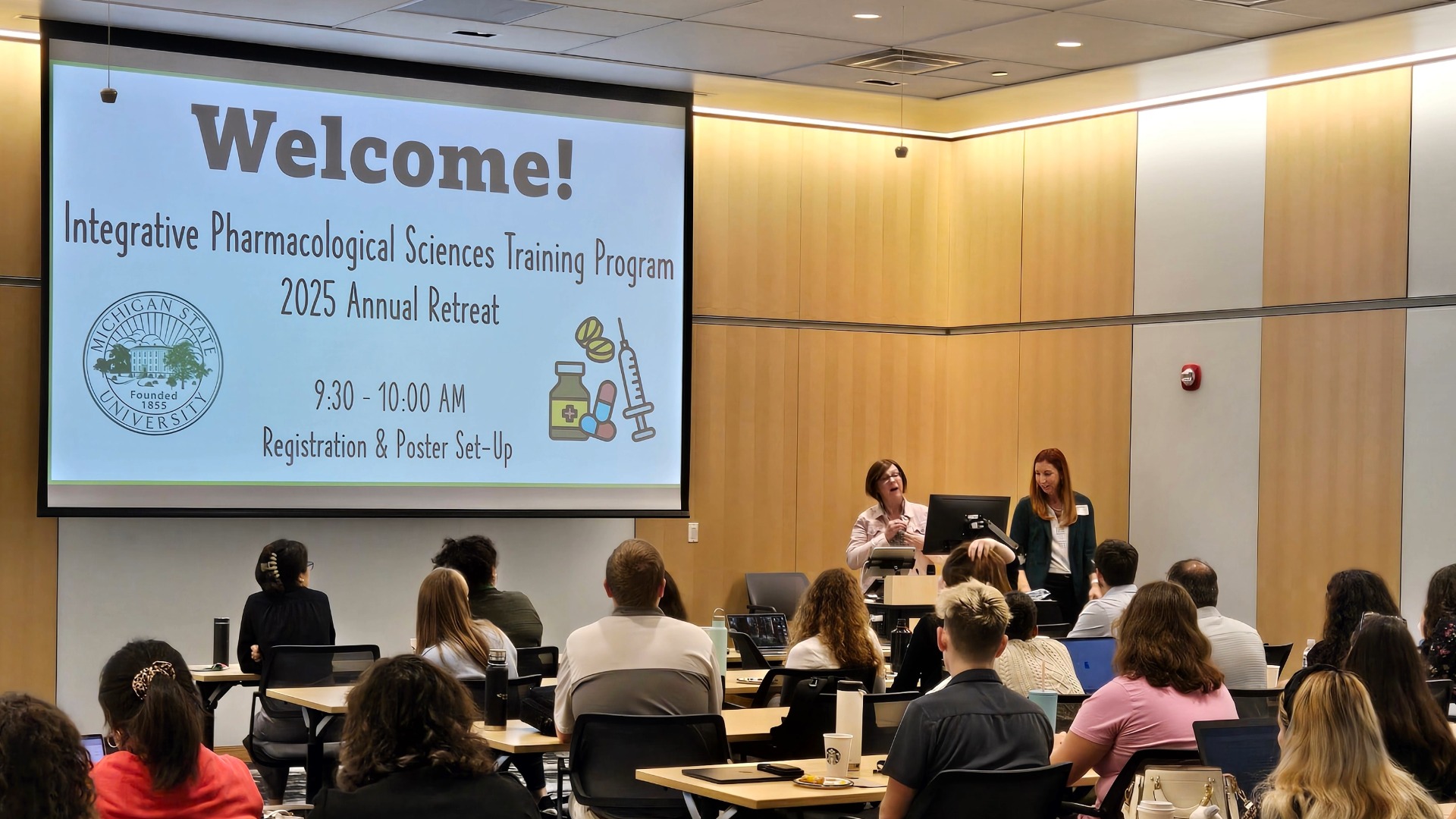
For more than four decades, Michigan State University's Integrative Pharmacological Sciences Training Program (IPSTP) has prepared graduate students to tackle some of the most complex challenges in biomedical research. Since receiving National Institutes of Health (NIH) support through a T32 training grant in 2011, with its most recent renewal in 2026, the program has expanded its reach, strengthened interdisciplinary collaboration and launched dozens of young scientists into successful careers in academia, industry and science communication.
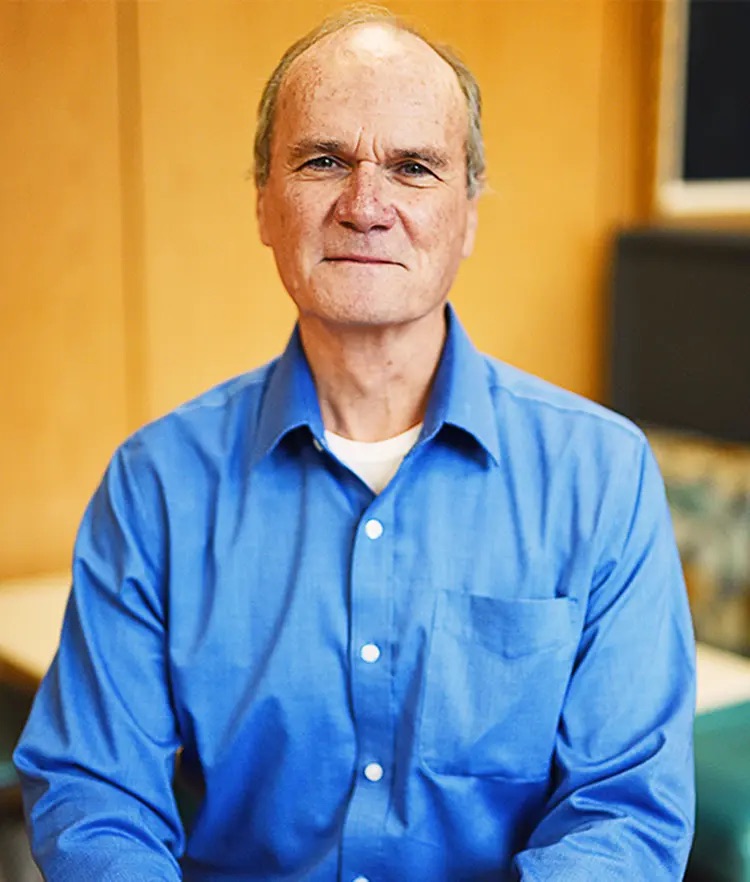 Originally established in 1979 by faculty in the MSU Colleges of Osteopathic Medicine, Human Medicine and Veterinary Medicine Department of Pharmacology and Toxicology, the IPSTP received its first NIH National Institute of General Medical Sciences (NIGMS) T32 training grant under the leadership of James Galligan, Ph.D., a professor in the department. Securing an inaugural T32 award is a significant accomplishment, as many of these highly competitive grants have been continuously funded at institutions across the country for decades.
“Dr. Galligan recognized something unique about pharmacology,” said Anne Dorrance, Ph.D., chair of the MSU Department of Pharmacology and Toxicology and co-director of the currently funded T32 training grant. “Our faculty were already training students from neuroscience, physiology, biochemistry, chemistry and other disciplines. He saw an opportunity to bring those students together into one cohesive program that would prepare them to solve scientific problems collaboratively.”
Unlike many scientific disciplines, pharmacology draws from multiple fields, including physiology, medicine, and chemistry. As a result, many graduate students conduct pharmacology research without being enrolled in a pharmacology-focused doctoral program. The IPSTP bridges that gap by providing students with a strong foundation in pharmacology and toxicology while fostering collaboration across scientific disciplines.
“I describe the IPSTP as a value-added program for Ph.D. students,” Dr. Dorrance said. “Students don’t just gain additional scientific knowledge. They learn how to work across disciplines, communicate with researchers from different backgrounds and solve problems as a team. Those are essential skills whether they pursue careers in academia, industry or beyond.”
The NIH training grant supports four graduate students annually for two years, while additional funding from the MSU Graduate School enables the program to include international students, further enriching the learning environment through diverse perspectives and experiences.
Since receiving T32 funding, the program has supported 72 graduate students who have trained with 42 faculty mentors across eight departments and programs spanning five colleges at MSU. Together, those trainees have co-authored 272 scientific publications, including 111 first-author papers.
The program’s impact extends well beyond publications. Nearly 95% of the program’s graduates have pursued careers in science. Alumni now serve as assistant professors at universities across the country, hold leadership positions at companies including Pfizer, Takeda, Eli Lilly and Bristol Myers Squibb and contribute to science through policy, advocacy and communication.
A hallmark of the IPSTP is its emphasis on professional development. Students participate in interdisciplinary journal clubs, grant-writing workshops and networking opportunities that prepare them for a variety of scientific careers.
“We help students become better scientific communicators,” said Gina Leinninger, Ph.D., professor in the Department of Physiology within the MSU College of Natural Science and co-director of the current T32-training grant. “They’re learning to explain their research to experts outside of their own discipline, which is critical because today’s scientific discoveries depend on collaboration.”
The program’s grant-writing workshop has become another defining feature. Through hands-on training, students develop competitive fellowship proposals while learning how to communicate compelling scientific ideas.
The IPSTP also helps students explore careers beyond academia by connecting them with pharmaceutical companies and alumni working throughout the biomedical research enterprise. Students tour industry laboratories, attend presentations from pharmaceutical leaders, and hear firsthand from graduates about their career paths.
“One of the most rewarding parts is seeing alumni return to share how the program prepared them for where they are today,” Dr. Leinninger said. “Current students can see that these careers are attainable and build connections with people who were once in their shoes.”
The program’s influence has also spread beyond its own trainees. Faculty leaders have expanded mentor training workshops to help graduate students and faculty across MSU become more effective mentors, while sharing their expertise with other training programs developing similar initiatives.
For Dr. Dorrance, the program’s greatest achievement isn’t measured by grants or publications, but by the collaborative culture it creates.
“Watching students from completely different scientific backgrounds learn to communicate with one another is amazing,” she said. “You see chemists talking with biologists, sharing ideas, helping each other solve problems and developing collaborations that wouldn’t have happened otherwise. That’s where innovation happens.”
As the IPSTP continues to evolve, its leaders remain committed to preparing the next generation of biomedical scientists while building on the foundation established by Dr. Galligan.
By Andrea Mackey
For more than four decades, Michigan State University's Integrative Pharmacological Sciences Training Program (IPSTP) has prepared graduate students to tackle some of the most complex challenges in biomedical research. Since receiving National Institutes of Health (NIH) support through a T32 training grant in 2011, with its most recent renewal in 2026, the program has expanded its reach, strengthened interdisciplinary collaboration and launched dozens of young scientists into successful careers in academia, industry and science communication.
Originally established in 1979 by faculty in the MSU Colleges of Osteopathic Medicine, Human Medicine and Veterinary Medicine Department of Pharmacology and Toxicology, the IPSTP received its first NIH National Institute of General Medical Sciences (NIGMS) T32 training grant under the leadership of James Galligan, Ph.D., a professor in the department. Securing an inaugural T32 award is a significant accomplishment, as many of these highly competitive grants have been continuously funded at institutions across the country for decades.
“Dr. Galligan recognized something unique about pharmacology,” said Anne Dorrance, Ph.D., chair of the MSU Department of Pharmacology and Toxicology and co-director of the currently funded T32 training grant. “Our faculty were already training students from neuroscience, physiology, biochemistry, chemistry and other disciplines. He saw an opportunity to bring those students together into one cohesive program that would prepare them to solve scientific problems collaboratively.”
Unlike many scientific disciplines, pharmacology draws from multiple fields, including physiology, medicine, and chemistry. As a result, many graduate students conduct pharmacology research without being enrolled in a pharmacology-focused doctoral program. The IPSTP bridges that gap by providing students with a strong foundation in pharmacology and toxicology while fostering collaboration across scientific disciplines.
“I describe the IPSTP as a value-added program for Ph.D. students,” Dr. Dorrance said. “Students don’t just gain additional scientific knowledge. They learn how to work across disciplines, communicate with researchers from different backgrounds and solve problems as a team. Those are essential skills whether they pursue careers in academia, industry or beyond.”
The NIH training grant supports four graduate students annually for two years, while additional funding from the MSU Graduate School enables the program to include international students, further enriching the learning environment through diverse perspectives and experiences.
Since receiving T32 funding, the program has supported 72 graduate students who have trained with 42 faculty mentors across eight departments and programs spanning five colleges at MSU. Together, those trainees have co-authored 272 scientific publications, including 111 first-author papers.
The program’s impact extends well beyond publications. Nearly 95% of the program’s graduates have pursued careers in science. Alumni now serve as assistant professors at universities across the country, hold leadership positions at companies including Pfizer, Takeda, Eli Lilly and Bristol Myers Squibb and contribute to science through policy, advocacy and communication.
A hallmark of the IPSTP is its emphasis on professional development. Students participate in interdisciplinary journal clubs, grant-writing workshops and networking opportunities that prepare them for a variety of scientific careers.
“We help students become better scientific communicators,” said Gina Leinninger, Ph.D., professor in the Department of Physiology within the MSU College of Natural Science and co-director of the current T32-training grant. “They’re learning to explain their research to experts outside of their own discipline, which is critical because today’s scientific discoveries depend on collaboration.”
The program’s grant-writing workshop has become another defining feature. Through hands-on training, students develop competitive fellowship proposals while learning how to communicate compelling scientific ideas.
The IPSTP also helps students explore careers beyond academia by connecting them with pharmaceutical companies and alumni working throughout the biomedical research enterprise. Students tour industry laboratories, attend presentations from pharmaceutical leaders, and hear firsthand from graduates about their career paths.
“One of the most rewarding parts is seeing alumni return to share how the program prepared them for where they are today,” Dr. Leinninger said. “Current students can see that these careers are attainable and build connections with people who were once in their shoes.”
The program’s influence has also spread beyond its own trainees. Faculty leaders have expanded mentor training workshops to help graduate students and faculty across MSU become more effective mentors, while sharing their expertise with other training programs developing similar initiatives.
For Dr. Dorrance, the program’s greatest achievement isn’t measured by grants or publications, but by the collaborative culture it creates.
“Watching students from completely different scientific backgrounds learn to communicate with one another is amazing,” she said. “You see chemists talking with biologists, sharing ideas, helping each other solve problems and developing collaborations that wouldn’t have happened otherwise. That’s where innovation happens.”
As the IPSTP continues to evolve, its leaders remain committed to preparing the next generation of biomedical scientists while building on the foundation established by Dr. Galligan.
By Andrea Mackey