
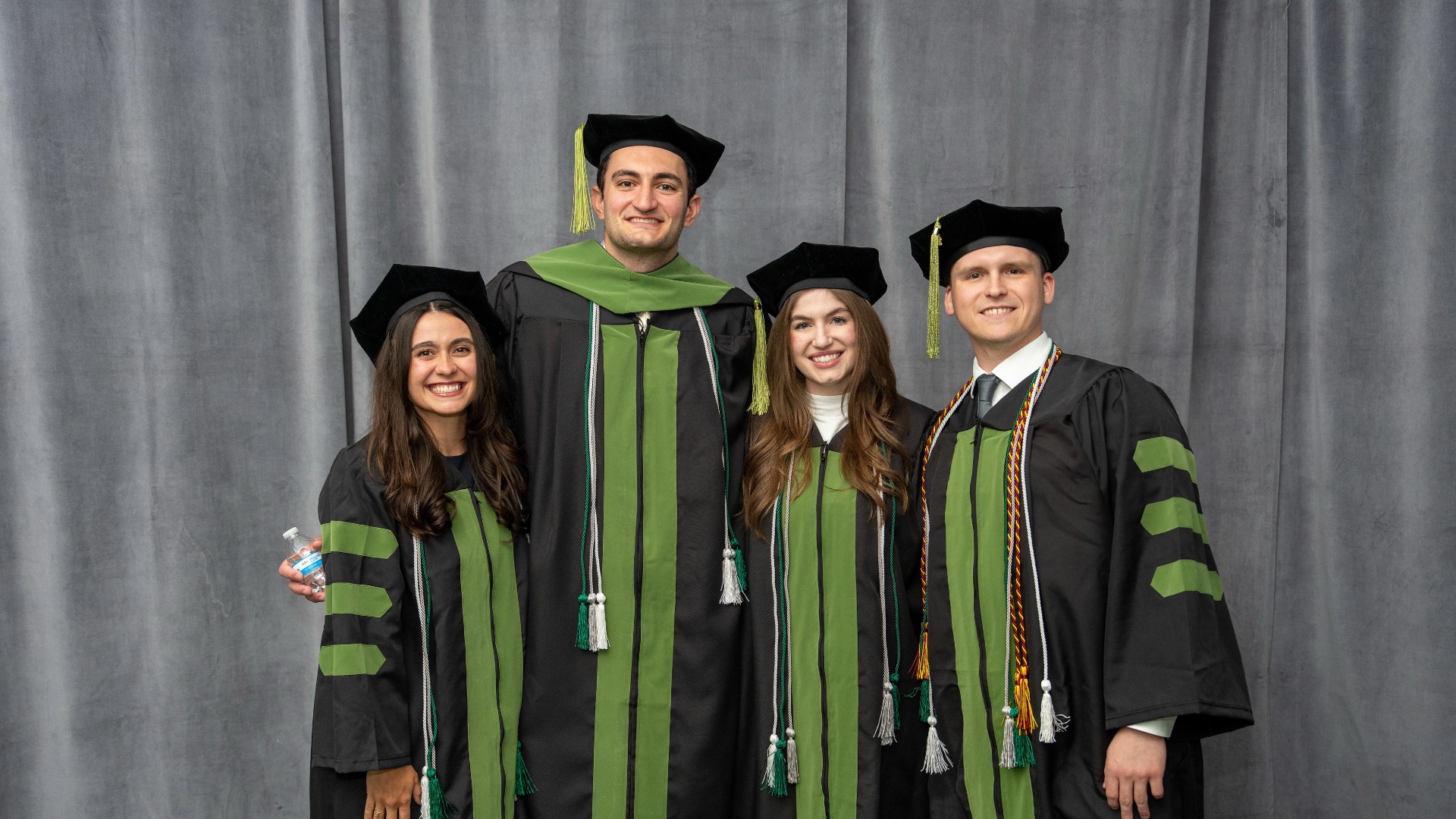
The Michigan State University College of Osteopathic Medicine saw its 263 new Doctors of Osteopathic Medicine (D.O.) hooded and cross the stage at commencement Thursday, April 30.
Among these new osteopathic physicians, 97% matched into 29 specialties in residencies, with 72% remaining in Michigan. Of the class, 39% of these D.O.s will do primary care residencies, and 44% of the class matched into residencies in the Graduate Medical Education Alliance.
The day began with graduates, faculty, staff, along with friends and family of the graduates for the annual banquet and awards ceremony.
Commencement followed that evening at the MSU Breslin Student Events Center. Dean Joyce deJong, D.O., opened the program with a message encouraging graduates to embrace their training and purpose. “You have been trained to take care of people. To step in. To lead. To do what needs to be done. You are ready to do that well,” she said to the D.O. Class of 2026.
Class President Evan Schumacher, D.O., followed with remarks focused on reflection and growth in the profession. “Each day, write down a story, the difference you made in a patient’s life, or the lesson a patient shared with you,” he said. “Watch how these small acts add up over time, shaping not just the physician you become, but the legacy you leave behind.”
The keynote address was delivered by Robert Piccinini, D.O., D. FACN, president of the American Osteopathic Association (AOA) and a 1992 graduate of MSUCOM. He encouraged graduates to remain grounded in empathy and advocacy throughout their careers.
“See the whole person. Not just the diagnosis, but the story behind it,” he said. “Protect your humanity. Burnout is not a personal failure. It's a system problem, and it requires courageous boundaries. Stand up for something bigger than yourself. Leadership doesn't require a title. It requires courage to advocate for patients, for your colleagues and for your profession that you now represent.”
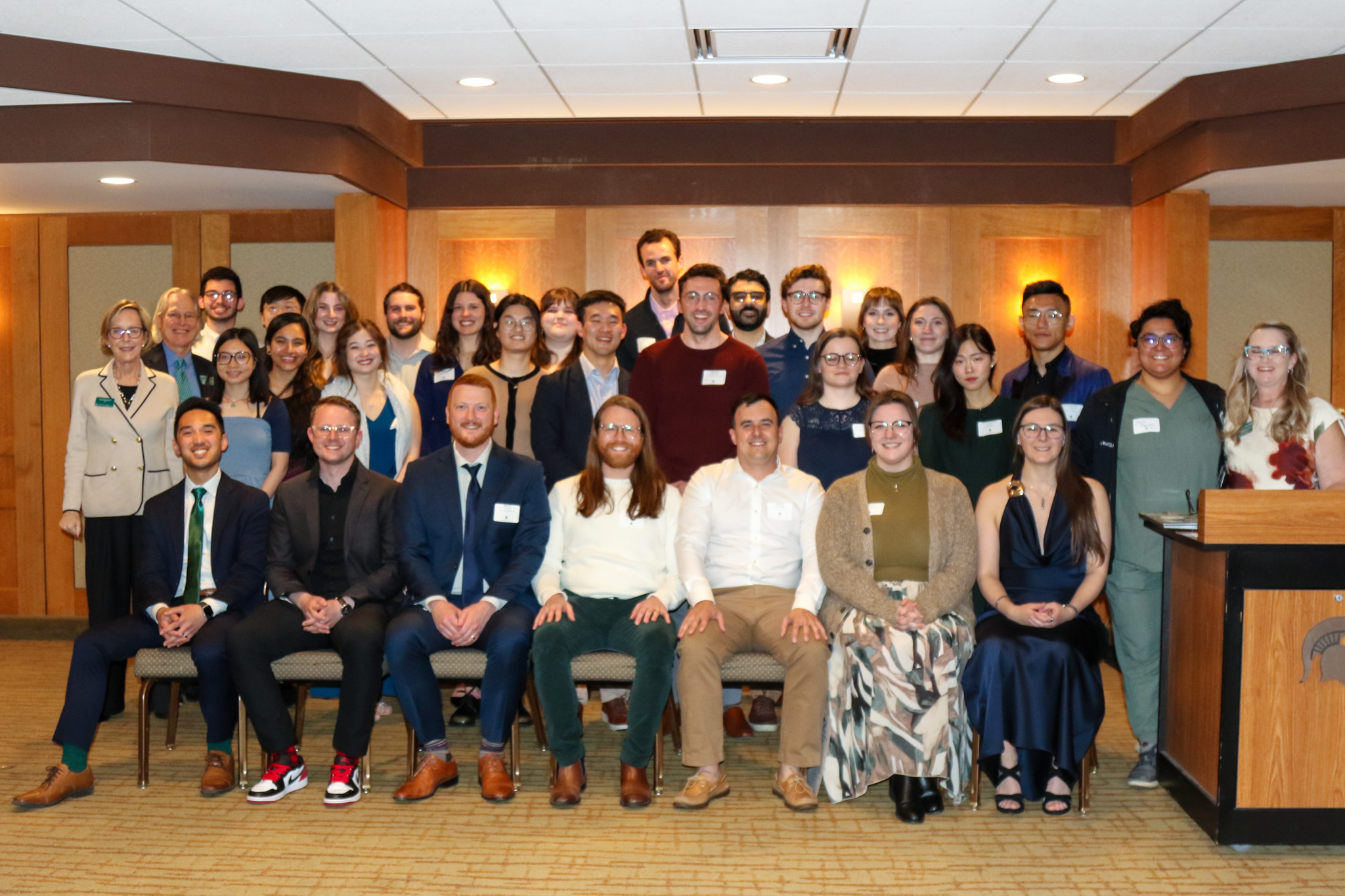
The celebration continued Saturday, May 2, where college leadership, faculty and staff gathered at the MSU University Club for a dinner honoring this year's D.O.-Ph.D. Medical Scientist Training Program graduates. This commencement marked the first for the program as part of the National Institutes of Health Medical Scientists Training Program. The designation was received in July 2025.
The D.O.-Ph.D. program included remarks from Dean deJong and this year’s featured speaker Jane Gudakunst, M.D., retired assistant professor for Family and Community Medicine at MSU.
Dean deJong encouraged the class to continue the strong work they began at MSUCOM. Dr. Gudakunst also challenged the new graduates to do well by their patients by telling the cohort they owed it to their patients to go all in without fear – take that leap, even early in their careers.
D.O.-Ph.D. graduates
Joshua Baker, D.O., Ph.D., Neuroscience
Dissertation: “Insights of Contemporary Diffusion Weighted Imaging Signal Modeling
Techniques on White Matter Microstructural Changes Following Mild Traumatic Brain Injury” | Advisor: David Zhu, Ph.D.
Nicholas Chargo, D.O., Ph.D., Molecular, Cellular and Integrative Physiology (MCIP)
Dissertation: “Investigation of Novel Approaches Targeting the Gut-Bone Axis to Promote Bone Health” | Advisor: Laura McCabe, Ph.D., and Narayanan Parameswaran, BVSc, MS, Ph.D.
Nicholas Giacobbi, D.O., Ph.D., Molecular, Cellular and Integrative Physiology (MCIP)
Dissertation: “Genome-Wide CRISPR/Cas9 Screens Reveal Epigenetic Immune Evasion Mechanisms in Human Papillomavirus-Positive Head and Neck Squamous Cell Carcinoma” | Advisor: Dohun Pyeon, Ph.D.
Jazib Gohar, D.O., Ph.D., Epidemiology
Dissertation: “The Impact of Area-Level Deprivation on Preterm Birth Risk among Black Women: Combining Epidemiological and Geospatial Approaches” | Advisor: Dawn Misra, Ph.D.
Alan Halim, D.O., Ph.D., Molecular, Cellular and Integrative Physiology (MCIP)
Dissertation: “Inhibition of miR-10b Treats Metastatic Breast Cancer by Targeting Stem Cell-like Properties” | Advisor: Anna Moore, Ph.D.
Melissa Meschkewitz, D.O., Ph.D., Biochemistry and Molecular Biology
Dissertation: “Investigation into Modulators of NFkB and MRTF/SRF-regulated Gene Transcription” | Advisor: Richard Neubig, M.D., Ph.D.
Megan Russ, D.O., Ph.D., Sociology
Dissertation: “Acquiescence at Sexual Debut and Sexual Function in Older Adults” | Advisor: Zhenmei Zhang, Ph.D., and Ning Hsieh, Ph.D.
Bradley Ryva, D.O., Ph.D., Pharmacology & Toxicology
Dissertation: “Endocrine Disrupting Chemicals and Gestational Hormones: Elucidating the Roles of Exogenous and Endogenous Factors Underlying Persistent Nausea in Pregnancy” | Advisor: Rita Strakovsky, Ph.D.
The Michigan State University College of Osteopathic Medicine saw its 263 new Doctors of Osteopathic Medicine (D.O.) hooded and cross the stage at commencement Thursday, April 30.
Among these new osteopathic physicians, 97% matched into 29 specialties in residencies, with 72% remaining in Michigan. Of the class, 39% of these D.O.s will do primary care residencies, and 44% of the class matched into residencies in the Graduate Medical Education Alliance.
The day began with graduates, faculty, staff, along with friends and family of the graduates for the annual banquet and awards ceremony.
Commencement followed that evening at the MSU Breslin Student Events Center. Dean Joyce deJong, D.O., opened the program with a message encouraging graduates to embrace their training and purpose. “You have been trained to take care of people. To step in. To lead. To do what needs to be done. You are ready to do that well,” she said to the D.O. Class of 2026.
Class President Evan Schumacher, D.O., followed with remarks focused on reflection and growth in the profession. “Each day, write down a story, the difference you made in a patient’s life, or the lesson a patient shared with you,” he said. “Watch how these small acts add up over time, shaping not just the physician you become, but the legacy you leave behind.”
The keynote address was delivered by Robert Piccinini, D.O., D. FACN, president of the American Osteopathic Association (AOA) and a 1992 graduate of MSUCOM. He encouraged graduates to remain grounded in empathy and advocacy throughout their careers.
“See the whole person. Not just the diagnosis, but the story behind it,” he said. “Protect your humanity. Burnout is not a personal failure. It's a system problem, and it requires courageous boundaries. Stand up for something bigger than yourself. Leadership doesn't require a title. It requires courage to advocate for patients, for your colleagues and for your profession that you now represent.”
The celebration continued Saturday, May 2, where college leadership, faculty and staff gathered at the MSU University Club for a dinner honoring this year's D.O.-Ph.D. Medical Scientist Training Program graduates. This commencement marked the first for the program as part of the National Institutes of Health Medical Scientists Training Program. The designation was received in July 2025.
The D.O.-Ph.D. program included remarks from Dean deJong and this year’s featured speaker Jane Gudakunst, M.D., retired assistant professor for Family and Community Medicine at MSU.
Dean deJong encouraged the class to continue the strong work they began at MSUCOM. Dr. Gudakunst also challenged the new graduates to do well by their patients by telling the cohort they owed it to their patients to go all in without fear – take that leap, even early in their careers.
D.O.-Ph.D. graduates
Joshua Baker, D.O., Ph.D., Neuroscience
Dissertation: “Insights of Contemporary Diffusion Weighted Imaging Signal Modeling
Techniques on White Matter Microstructural Changes Following Mild Traumatic Brain Injury” | Advisor: David Zhu, Ph.D.
Nicholas Chargo, D.O., Ph.D., Molecular, Cellular and Integrative Physiology (MCIP)
Dissertation: “Investigation of Novel Approaches Targeting the Gut-Bone Axis to Promote Bone Health” | Advisor: Laura McCabe, Ph.D., and Narayanan Parameswaran, BVSc, MS, Ph.D.
Nicholas Giacobbi, D.O., Ph.D., Molecular, Cellular and Integrative Physiology (MCIP)
Dissertation: “Genome-Wide CRISPR/Cas9 Screens Reveal Epigenetic Immune Evasion Mechanisms in Human Papillomavirus-Positive Head and Neck Squamous Cell Carcinoma” | Advisor: Dohun Pyeon, Ph.D.
Jazib Gohar, D.O., Ph.D., Epidemiology
Dissertation: “The Impact of Area-Level Deprivation on Preterm Birth Risk among Black Women: Combining Epidemiological and Geospatial Approaches” | Advisor: Dawn Misra, Ph.D.
Alan Halim, D.O., Ph.D., Molecular, Cellular and Integrative Physiology (MCIP)
Dissertation: “Inhibition of miR-10b Treats Metastatic Breast Cancer by Targeting Stem Cell-like Properties” | Advisor: Anna Moore, Ph.D.
Melissa Meschkewitz, D.O., Ph.D., Biochemistry and Molecular Biology
Dissertation: “Investigation into Modulators of NFkB and MRTF/SRF-regulated Gene Transcription” | Advisor: Richard Neubig, M.D., Ph.D.
Megan Russ, D.O., Ph.D., Sociology
Dissertation: “Acquiescence at Sexual Debut and Sexual Function in Older Adults” | Advisor: Zhenmei Zhang, Ph.D., and Ning Hsieh, Ph.D.
Bradley Ryva, D.O., Ph.D., Pharmacology & Toxicology
Dissertation: “Endocrine Disrupting Chemicals and Gestational Hormones: Elucidating the Roles of Exogenous and Endogenous Factors Underlying Persistent Nausea in Pregnancy” | Advisor: Rita Strakovsky, Ph.D.