
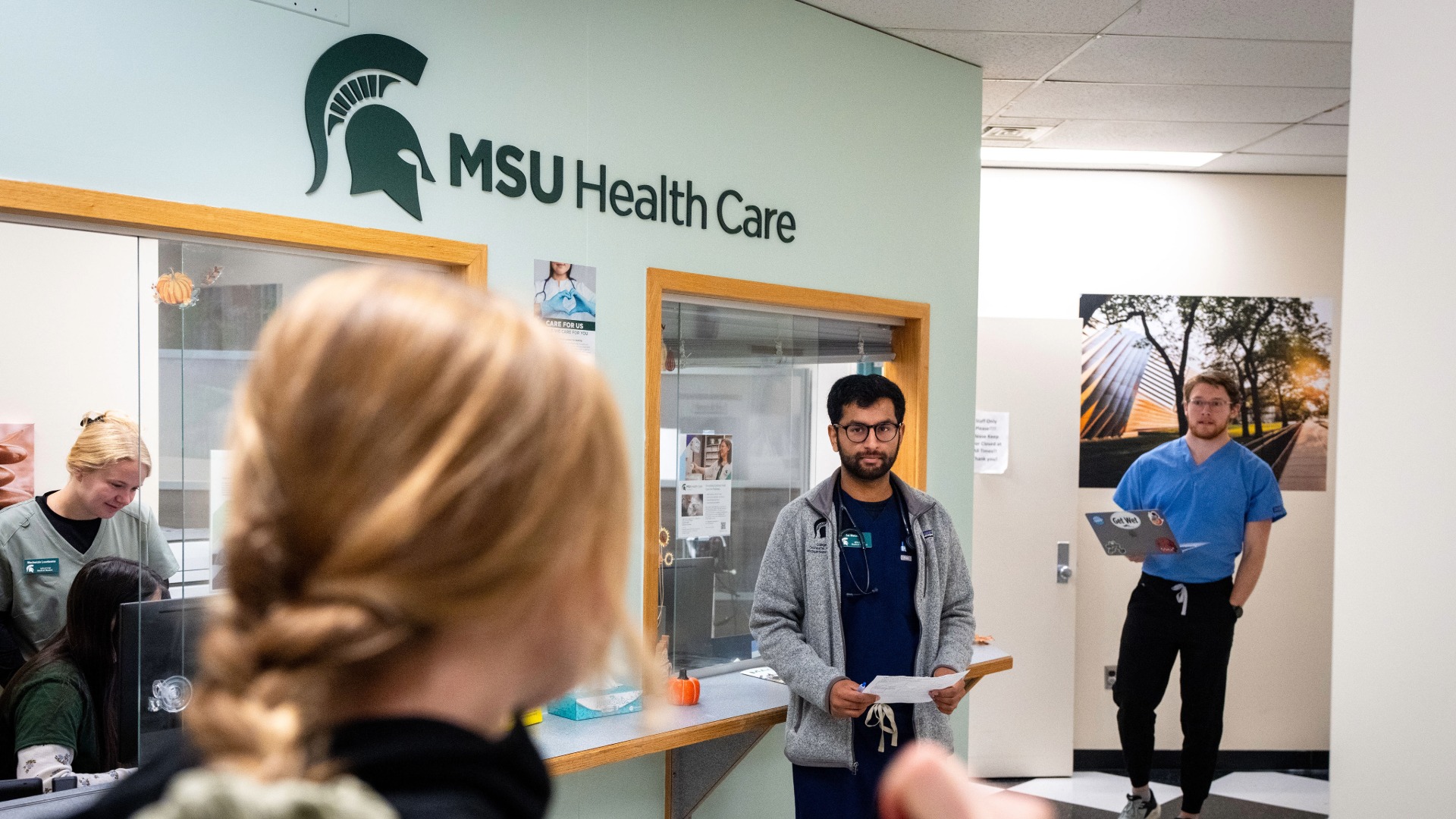
Twice a month, medical students at the Michigan State University College of Osteopathic Medicine meet patients in the MSU CARE (Community Access, Resources and Education) Clinic – a medical student-run clinic in East Lansing, Mich. The team of students and physicians who work with them open the doors to uninsured and underinsured patients who may otherwise struggle to access care. The clinic serves as both a critical access point for members of the community who need consistent medical support and a learning environment for medical students.
Similar to a primary care office, the clinic provides many services, including routine visits, prescriptions, lab testing and referrals for imaging. Its larger mission is to serve as a consistent point of care for patients until they are able to secure insurance and connect with long-term providers.
“Our goal is to be a community touchpoint for patients who are either uninsured or underinsured,” said Ryan Keating, D.O., and neurologist at Michigan State University College of Osteopathic Medicine, who helps oversee the clinic. “We want to be their primary continuous care provider until they are able to get connected elsewhere.”
The clinic officially launched in April 2025 after nearly two years of planning. The idea began with three medical students who saw a need for more continuous care options in the Lansing area. While existing outreach efforts, such as health fairs and street medicine programs, meet important needs, they often do not provide the kind of ongoing primary care many patients require.
That gap is what this clinic was designed to fill. The goal was to create a stable location where patients could return for follow-up care and build ongoing relationships with providers while students gain early clinical experience.
Dr. Keating said the clinic’s student-run model is one of its defining features. First- and second-year osteopathic medical students help lead patient care from start to finish, while faculty physicians supervise and support them throughout the process.
“We try to make sure students feel comfortable in a clinical setting very early on,” Dr. Keating said. “That way, the patients who come here feel comfortable, too.”
Students begin with foundational responsibilities, such as patient check-in, intake and vital signs. As they gain experience, they move into more advanced roles, including taking full patient histories, performing physical exams and presenting cases to supervising physicians. The structure mirrors the collaborative learning environment students experience later in their clinical training.
The MSU CARE Clinic also recognizes that health care access extends beyond the exam room. A student resource team works with patients to connect them to services, such as food assistance, housing support and insurance enrollment programs. For many patients, these additional resources are essential to improving long-term health outcomes.
Transportation can also be a barrier to receiving care. Because of this, the clinic has partnered with Lansing’s Capital Area Transportation Authority (CATA) to provide free bus passes for patients who need help getting to appointments.
Currently, the clinic operates every second and fourth Saturday of each month and typically sees one to three patients per session. Although patient numbers remain small during the early stage, organizers say the focus has been on building a strong and reliable system for care.
“A lot of this year has been process and policy creation,” Dr. Keating said. “We want to make sure the system works well so that as we grow, we can continue to care for patients efficiently.”
That growth is already part of the long-term vision. Organizers hope the clinic will eventually expand its hours and become a larger community access point for free care. In the future, the team also hope to collaborate with specialists within the MSU Health Care system to host dedicated clinic days that would provide free specialty consultations for patients who need services such as neurology, cardiology or gastroenterology.
For Dr. Keating, one of the most meaningful parts of the clinic is the opportunity to work closely with medical students who are eager to serve others while developing their clinical skills.
“It is interesting to watch students develop those skills in real time,” he said. “It has helped me grow as an educator, and it is rewarding to see how committed they are to helping the community.”
What started as a student idea has grown into something larger. The clinic expands access to care while helping shape the next generation of physicians. For patients, it offers a place to turn. For students, it offers a place to learn. For the Lansing community, it represents a model of care rooted in service, continuity and compassion.
By Terri Hughes-Lazzell